Local SEO Basics for Beginners In Sri Lanka In 2026; Proven Facts
If you run a business in Sri Lanka — whether it is a guesthouse in Galle, a restaurant in Colombo, a beauty salon in Kandy, or a hardware shop in Kurunegala — local SEO is one of the most powerful and cost-effective tools available to you right now.
Every day, thousands of people across Sri Lanka open Google and search for businesses near them. They search for “restaurants in Colombo 3,” “car service in Nugegoda,” “wedding photographers in Kandy,” and hundreds of other local queries. If your business does not appear in those results, a competitor who has taken the time to optimize their online presence will get that customer instead of you.
This guide will walk you through everything you need to know about local SEO basics for beginners, written specifically for Sri Lankan business owners. No complicated technical language. No assumptions that you have a big budget. Just clear, practical steps you can start using today.
What Is Local SEO?
In my experience, local SEO is the practice of optimizing your business online so that it appears when people nearby search for your products or services on Google. It is different from regular SEO because it focuses specifically on location-based searches — people looking for something in a specific city, area, or neighborhood.
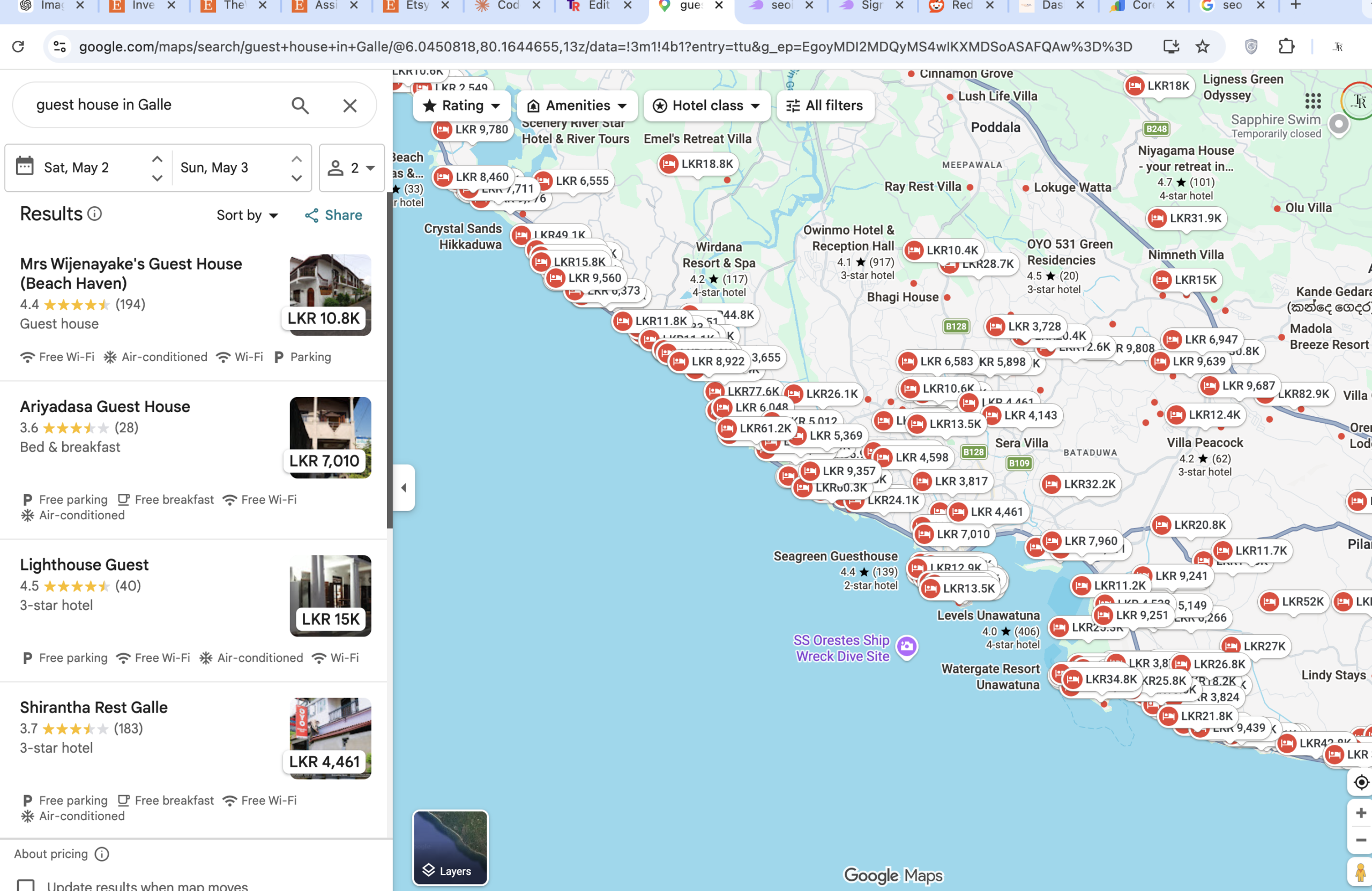
For example, when someone in Negombo searches “best seafood restaurant near me,” or when a tourist in Galle Fort types “guest house in Galle,” local SEO is what determines which businesses appear at the top of those results.
Why Local SEO Matters More Than Ever in Sri Lanka?
Sri Lanka’s digital usage has changed dramatically over the past few years. Mobile internet use has improved a lot, Google has become the default way people discover local businesses, and customers increasingly rely on online reviews before making a decision.
Here are some numbers that show the scale of the opportunity:
- 69% of all Google searches are looking for local information
- 87% of consumers used Google to evaluate a local business before visiting
- 42% of local searches result in a click on the Google Map Pack — the top section of results showing a map with three businesses
- Consumers who find a business through local search view an average of 3.92 pages per visit — far more than visitors from paid ads
- People who search locally visit a business within 5 miles at a very high rate
For Sri Lankan businesses, these numbers carry extra weight. With tourism recovering strongly, more international visitors are using Google to find hotels, restaurants, tuk-tuk services, spas, and tour operators.
At the same time, local customers in cities like Colombo, Kandy, Galle, and Jaffna are becoming more comfortable finding and evaluating businesses entirely online before stepping through the door.
If you are not visible on Google, you are invisible to a massive portion of your potential customers.
How Google Decides Which Local Businesses to Show?
Before you start optimizing, it helps to understand how Google actually chooses which businesses to display in local search results. Google uses three core signals:
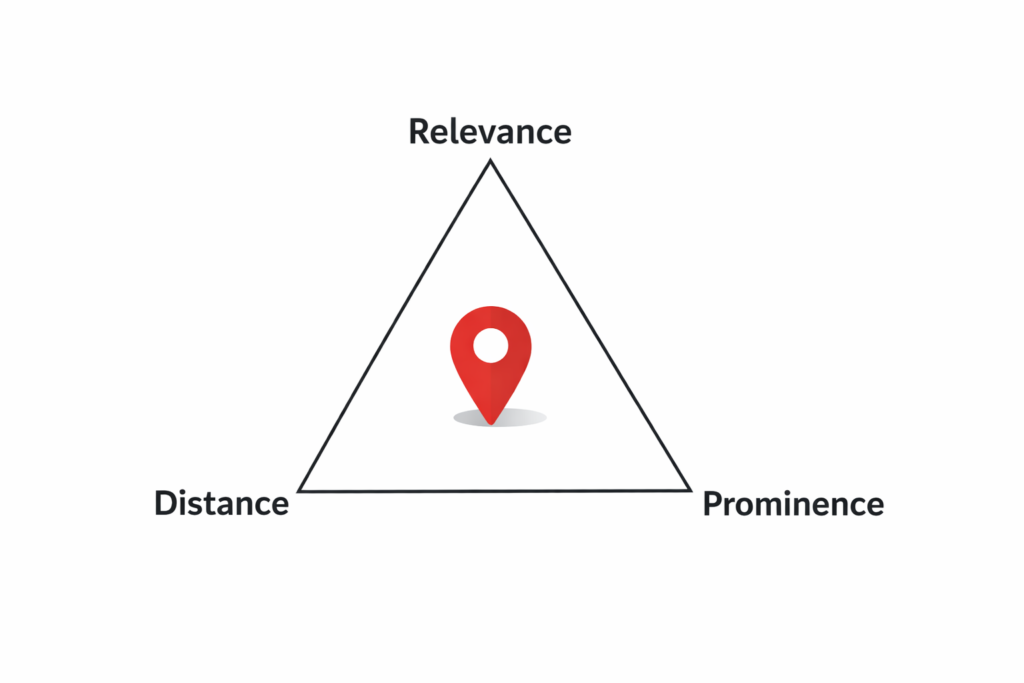
Relevance
How closely does your business match what the person is searching for? If someone searches “Ayurvedic spa in Colombo,” Google will look for businesses whose profiles and websites clearly describe that service in that location. The more specific and complete your business information is, the better Google can match you to the right searches.
Distance
How close is your business to the person searching, or to the location they mentioned? Someone in Nugegoda searching for a plumber will see results physically close to them, not someone based in Gampaha. This is why it is important to clearly establish your exact location across all platforms.
Prominence
How well-known and trusted is your business online? Google looks at factors like your number of reviews, the quality of those reviews, how many other websites mention or link to you, and how complete your business profile is. A restaurant in Kandy with 200 Google reviews will typically outrank a similar restaurant with only 10 reviews, assuming other factors are equal.
These three signals work together. You cannot simply focus on one and ignore the others — you need to work on all three consistently.
Understanding the Local Pack
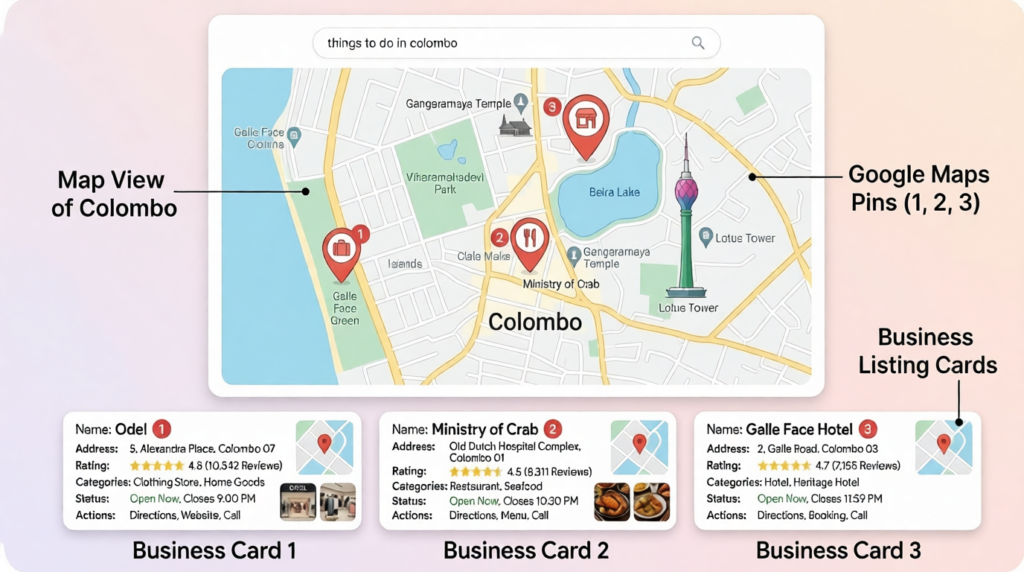
When you search for almost any local business on Google, you will see a special section near the top of the results page — a map with three business listings shown below it. This is called the Local Pack, sometimes called the Map Pack.
This is the most valuable real estate in local search. It appears above regular website results, which means users see it first. Each listing shows your business name, star rating, address, phone number, and whether you are currently open.
For Sri Lankan businesses, appearing in the Local Pack for your city or area can dramatically increase calls, walk-ins, and website visits — completely for free, without any advertising spend.
Key Elements of Local SEO
01. NAP Consistency — The Foundation of Everything
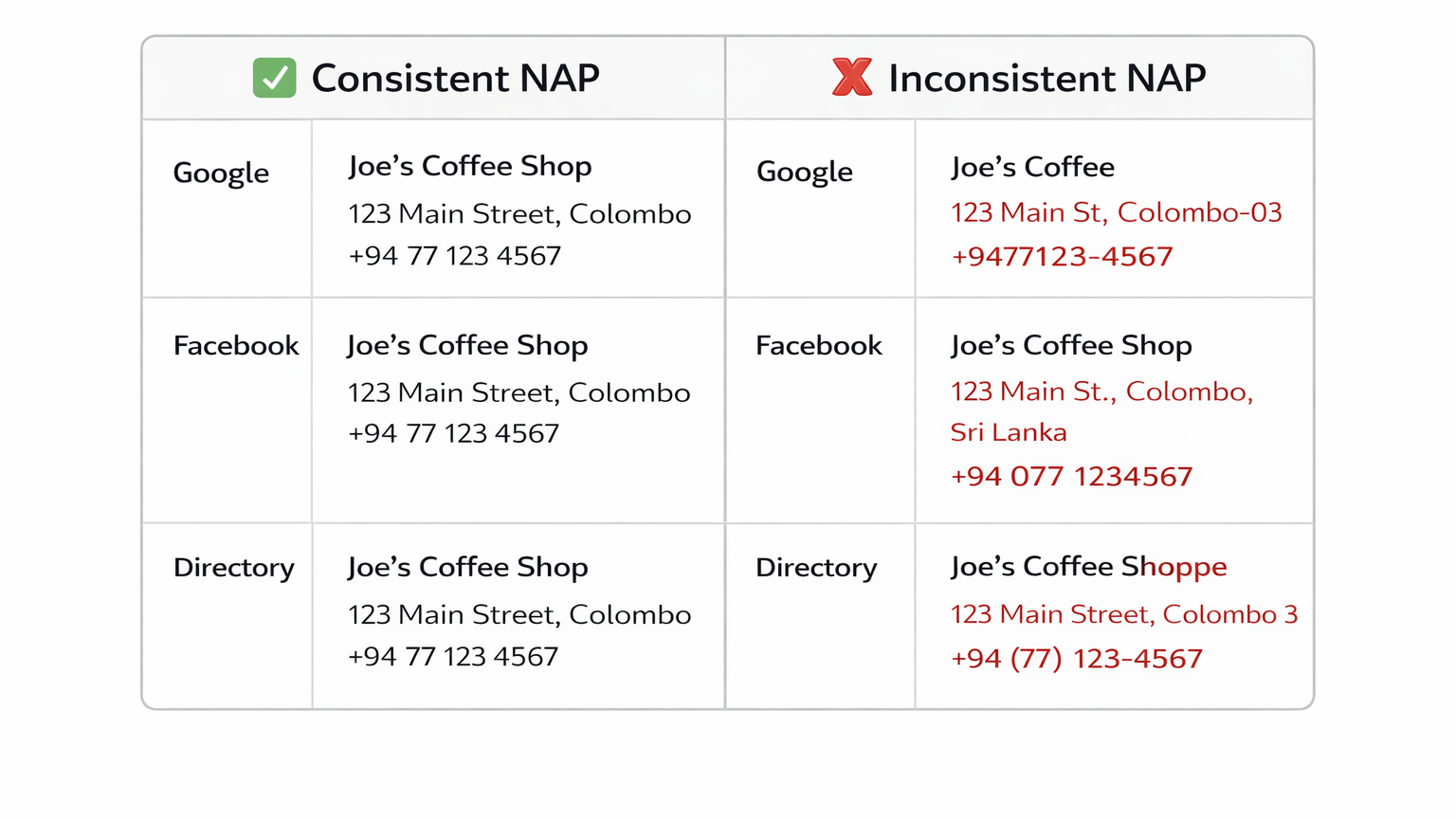
NAP stands for Name, Address, and Phone Number. These three pieces of information must be exactly the same everywhere your business appears online — your website, Google Business Profile, Facebook page, and any directories.
Even small differences cause problems. “No. 45, Galle Road, Colombo 03” and “45 Galle Rd, Colombo 3” are technically the same address, but Google may treat them as two different locations, which confuses the algorithm and lowers your rankings.
Sri Lankan businesses often have this problem because addresses can be written in many different formats, and phone numbers can appear with or without the country code (+94). Pick one format and use it everywhere, every time.
02. Your Google Business Profile — Your Most Important Asset
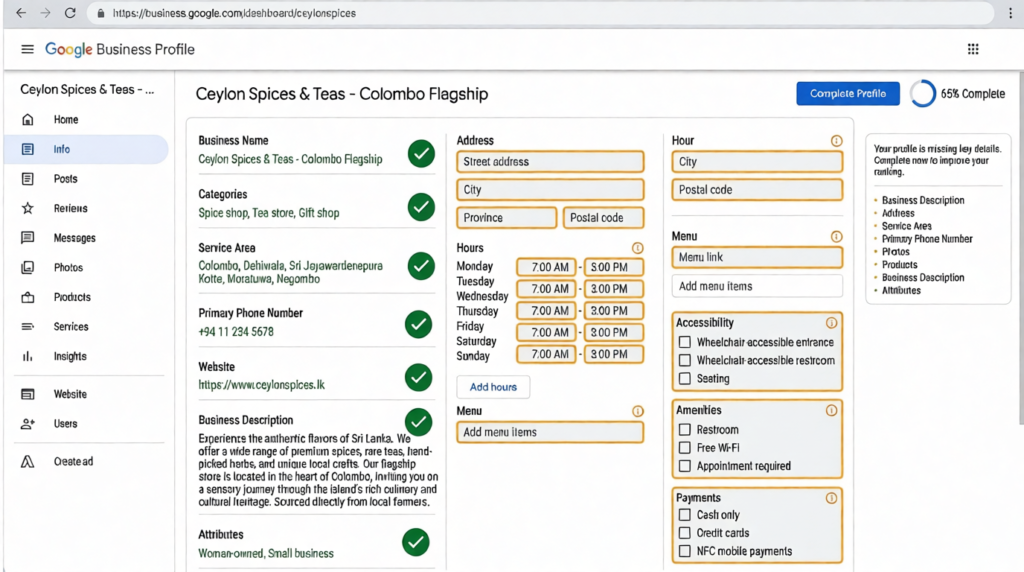
Google Business Profile (previously called Google My Business) is a free tool that lets you control how your business appears on Google Search and Google Maps. For most Sri Lankan businesses, this is the single most important thing to set up correctly.
A well-optimized Google Business Profile means you can appear in the Local Pack, in Google Maps, and in a Knowledge Panel (the information box that appears on the right side of search results) — all without spending anything on advertising.
What to include:
- Your exact business name (do not add keywords to your name — Google may penalize this)
- Your full address including the district and city
- Your local Sri Lankan phone number with the country code (+94)
- Your website URL
- Your business category (be as specific as possible — “Ayurvedic Spa” is better than just “Spa”)
- Your opening and closing hours, including public holidays
- A detailed business description with relevant keywords
- High-quality photos of your premises, products, team, and services
Sri Lanka tip: If you serve tourists as well as locals, consider writing your business description in English. If you primarily serve local customers, you may want to add content in Sinhala or Tamil as well, as Google increasingly supports multilingual profiles.
03. Local Keywords — Speaking the Language of Your Customers
Keywords are the words and phrases your potential customers type into Google. For local SEO, you need to use keywords that combine your service with your location.
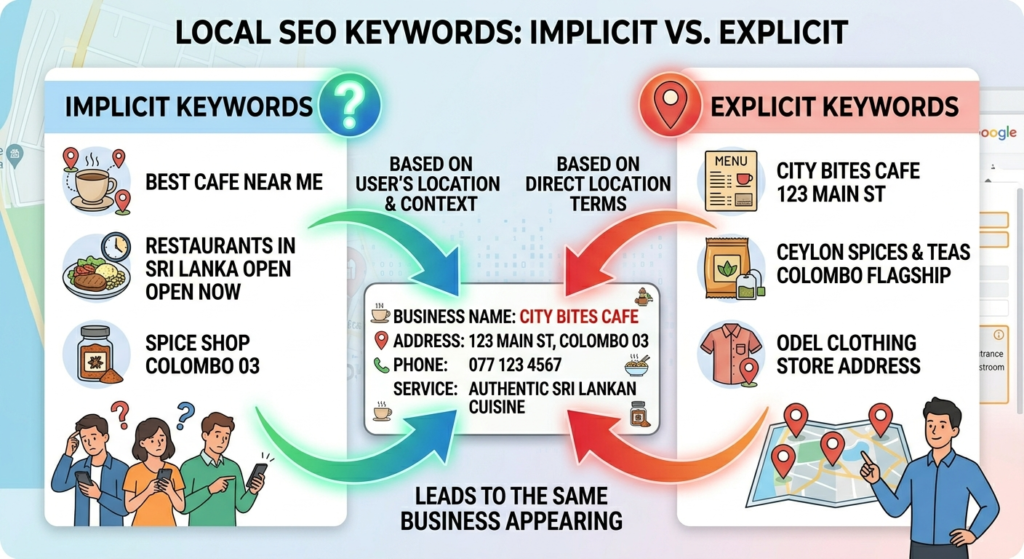
There are two types of local keywords:
Implicit keywords — the user does not mention a location but Google uses their GPS to show nearby results.
- “pizza delivery“
- “car wash near me”
- “wedding florist“
Explicit keywords — the user includes a location in their search.
- “pizza delivery in Colombo“
- “car wash in Nugegoda“
- “wedding florist in Kandy“
You need to target both types. Optimize your website content clearly around your location so Google connects you to implicit searches, and use explicit location-based phrases throughout your website so you also rank for people typing city names.
Sri Lanka-specific keyword examples by business type:
| Business Type | Example Explicit Keywords |
|---|---|
| Hotel / Guesthouse | “boutique hotel in Galle Fort,” “guesthouse in Negombo near beach” |
| Restaurant | “best rice and curry in Kandy,” “seafood restaurant Mirissa” |
| Beauty Salon | “hair salon in Colombo 07,” “bridal makeup artist in Nugegoda” |
| Tour Operator | “day tour from Colombo,” “safari tour Yala,” “Sigiriya tour from Kandy” |
| Medical / Dental | “dentist in Rajagiriya,” “private doctor Gampaha” |
| Retail Shop | “electronics shop in Pettah,” “fabric store Kandy” |
| Car Services | “vehicle service centre Maharagama,” “tyre shop Kurunegala” |
Use these types of phrases naturally in your website page titles, headings, descriptions, and content.
04. Local Citations — Getting Your Business Mentioned Online
A local citation is any mention of your business name, address, and phone number on another website. This includes online directories, social media platforms, review sites, and local blogs.
Citations send a trust signal to Google — the more consistent, accurate mentions of your business that exist online, the more confident Google is that your business is legitimate and located where you say it is.
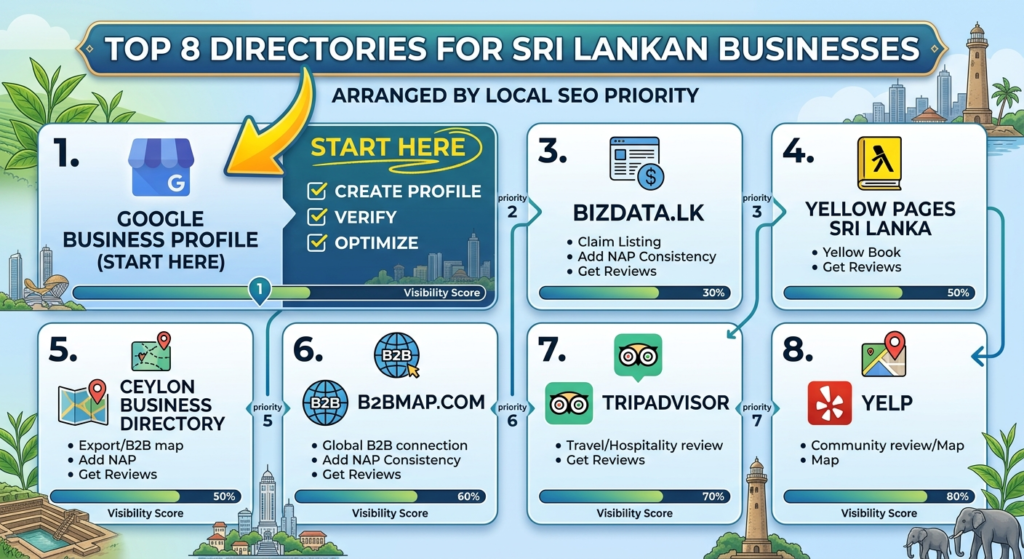
Key directories for Sri Lankan businesses:
| Directory | Best For |
|---|---|
| Google Business Profile | Every business — top priority |
| Facebook Business Page | All businesses — very high local usage in Sri Lanka |
| TripAdvisor | Hotels, restaurants, tour operators, attractions |
| Booking.com | Accommodation |
| Agoda | Accommodation |
| Airbnb | Short-term rentals |
| Sri Lanka Tourism Board (srilanka.travel) | Tourism-related businesses |
| Yelp | General businesses |
| Yellow Pages Sri Lanka (yellowpages.lk) | General businesses |
| Justdial Sri Lanka | General local businesses |
| B2B services, professional services |
Sri Lanka tip: TripAdvisor carries especially strong weight for businesses that serve tourists. If you run a guesthouse, restaurant, spa, or tour company, a strong TripAdvisor profile can significantly boost your visibility on Google as well.
05. Customer Reviews
In Sri Lanka, word of mouth has always been how businesses grow. Local SEO is simply the digital version of that. Customer reviews are one of the most powerful signals in local SEO and one of the biggest factors in whether a customer chooses you over a competitor.
- Businesses with more positive reviews rank higher in local results
- Customers read reviews before deciding — positive reviews build immediate trust
- Responding to reviews (positive and negative) shows Google and customers that you are an engaged, reliable business
How to get more reviews from Sri Lankan customers:
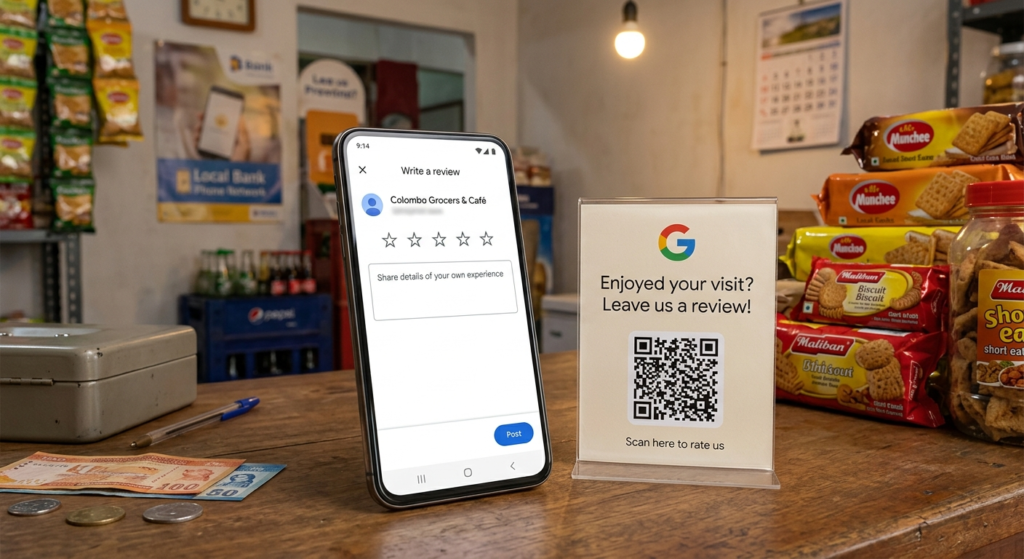
After completing a service, simply ask: “If you are happy with our service, would you mind leaving us a quick review on Google? It really helps our small business.“
Put a printed QR code on your counter, on receipts, or on your menu — customers can scan it and go directly to your review page
Include a review link in your WhatsApp messages to customers (WhatsApp is extremely popular in Sri Lanka and is a very effective way to follow up)
For accommodation: send a message through Booking.com or Airbnb asking for a review after check-out
How to handle negative reviews: Do not ignore them. Respond calmly and professionally. Other customers will see how you handle complaints, and a thoughtful response to a negative review can actually increase trust rather than reduce it.
How to Start Local SEO: Step by Step for Sri Lankan Businesses
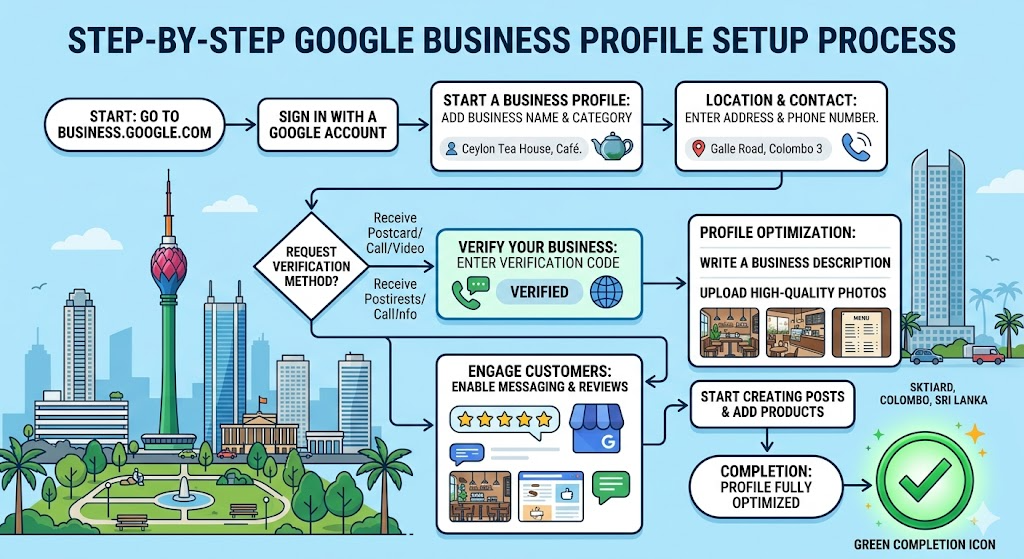
Step 1: Set Up and Fully Optimize Your Google Business Profile
Go to business.google.com and claim or create your listing. This is free and is the single most impactful thing you can do for local SEO.
Fill in every single field:
- Business name (exactly as it appears on your signboard — do not add extra keywords)
- Full address with district
- Phone number with +94 country code
- Website
- Business category (choose the most specific option available)
- Opening hours
- A detailed description mentioning your services and location
- Upload at least 10 high-quality photos
Sri Lanka tip: Google Maps data in Sri Lanka is still developing in some areas. If your business location is not pinpointed accurately on the map, drag the pin manually to the correct spot. This is important — especially in areas where roads are not fully mapped, like parts of the North, East, or hill country.
Step 2: Optimize Your Website for Local Keywords
Your website is your online home, and it needs to speak clearly to Google about what you do and where you are located.
What to do:
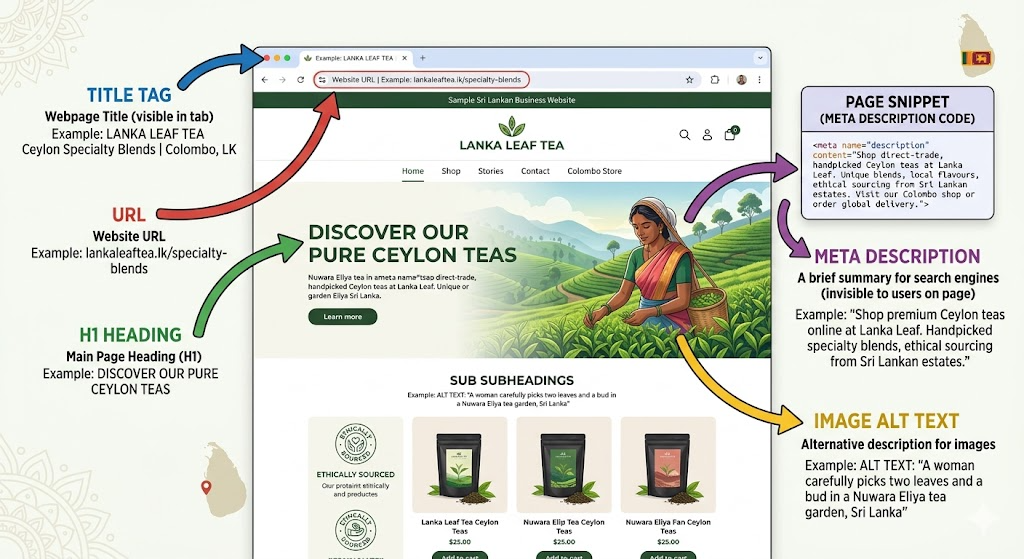
Page titles — Include your service and location.
Example: Best Ayurvedic Spa in Colombo | Serenity Wellness Centre
Meta descriptions — A short summary that appears under your link in search results.
Example: Enjoy traditional Ayurvedic treatments at our award-winning spa in Colombo 07. Book your appointment online or call us today.
Headings (H1, H2) — Use your main keyword in the main heading of each page.
Example: H1: Authentic Ayurvedic Spa Treatments in Colombo
URLs — Keep them clean and include your location.
Example:
yourwebsite.com/ayurvedic-spa-colombo
Body content — Mention your city and neighbourhood naturally throughout your content. Do not force it — write for your customers first, then make sure the location is clear.
Image alt text — Every photo on your website should have a description.
Example:
alt="traditional Ayurvedic massage room at our Colombo spa"
Step 3: Add Local Business Structured Data to Your Website
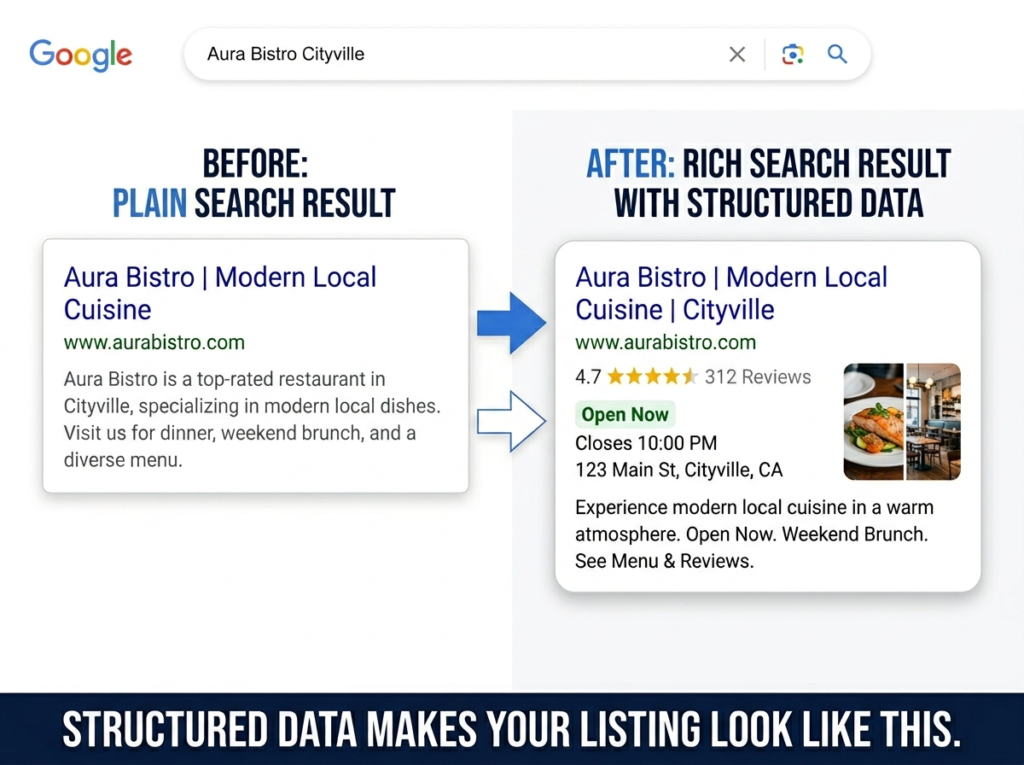
Structured data is a small piece of code added to your website that gives Google very specific information about your business — your address, opening hours, phone number, price range, and more.
When Google reads this correctly, it can show your business as a rich result — with star ratings, opening hours, and photos displayed directly in the search results page, before the customer even clicks. This makes your listing stand out dramatically compared to competitors who have not added structured data.
For Sri Lankan businesses using WordPress: Plugins like RankMath or Yoast SEO will add this automatically once you configure your business details. If you have a developer managing your site, ask them to add Local Business schema from Schema.org.
What to include in your structured data:
- Business name, address, phone number
- Opening hours
- Business type (Restaurant, Hotel, SpaType, AutoRepair, etc.)
- Price range
- Accepted currencies (LKR)
- Geographic coordinates
Step 4: Make Your Website Fast and Mobile-Friendly
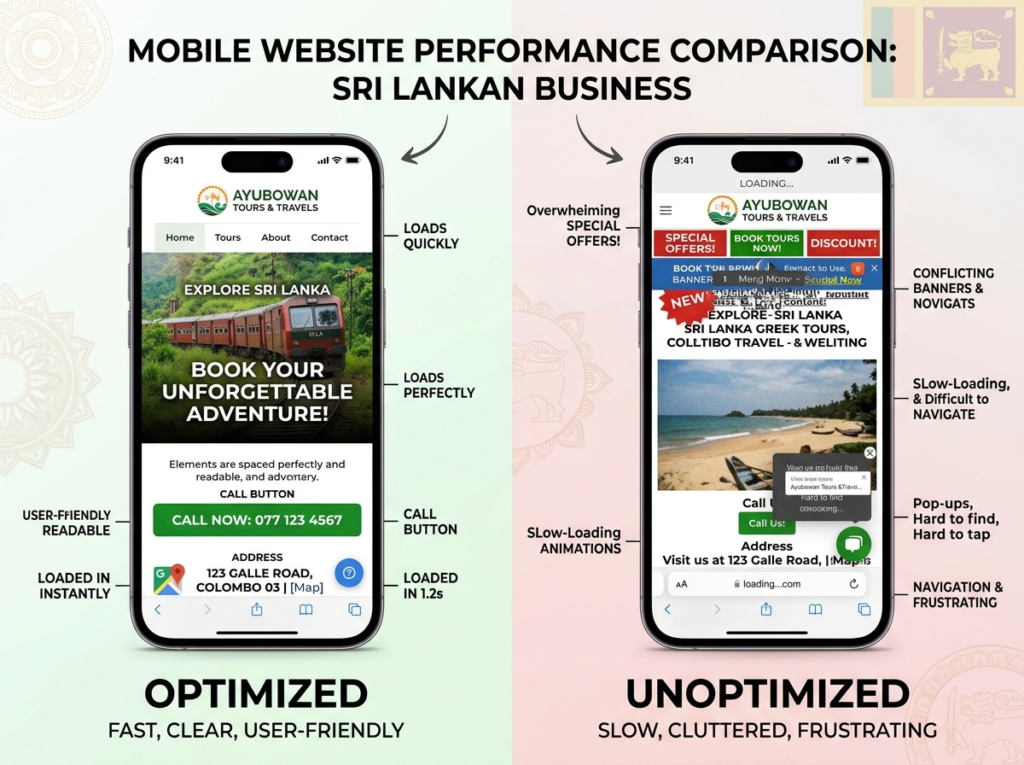
In Sri Lanka, most local searches happen on mobile phones — often on 4G connections that may not always be fast. If your website takes more than 3 seconds to load, the majority of visitors will leave before seeing your content.
Check your website speed for free at: pagespeed.web.dev
Key things to fix:
- Compress your images before uploading (use a free tool like TinyPNG)
- Use a reliable Sri Lankan or regional web hosting provider — hosting location affects load speed
- Make sure buttons are large enough to tap on a phone
- Include a click-to-call button prominently (many Sri Lankan customers prefer to call before visiting)
- Show your address with a Google Maps link so customers can navigate directly to you
Step 5: Build Local Citations Across Sri Lankan Directories
List your business consistently across all relevant directories. Start with the most important ones and work your way down the list provided earlier in this guide.
Key rules:
- Your NAP must be identical everywhere
- Use the same format for your phone number every time (we recommend +94 XX XXX XXXX)
- Use the same business name every time — do not abbreviate on some platforms and write in full on others
- If you have a Facebook page, make sure your address and contact details are fully filled in — Facebook is one of the most-checked platforms by Sri Lankan customers
Sri Lanka tip: Many Sri Lankan businesses have Facebook pages but no Google Business Profile. This is a missed opportunity. Google is where the search happens — Facebook is where the community happens. You need both.
Step 6: Build Local Backlinks
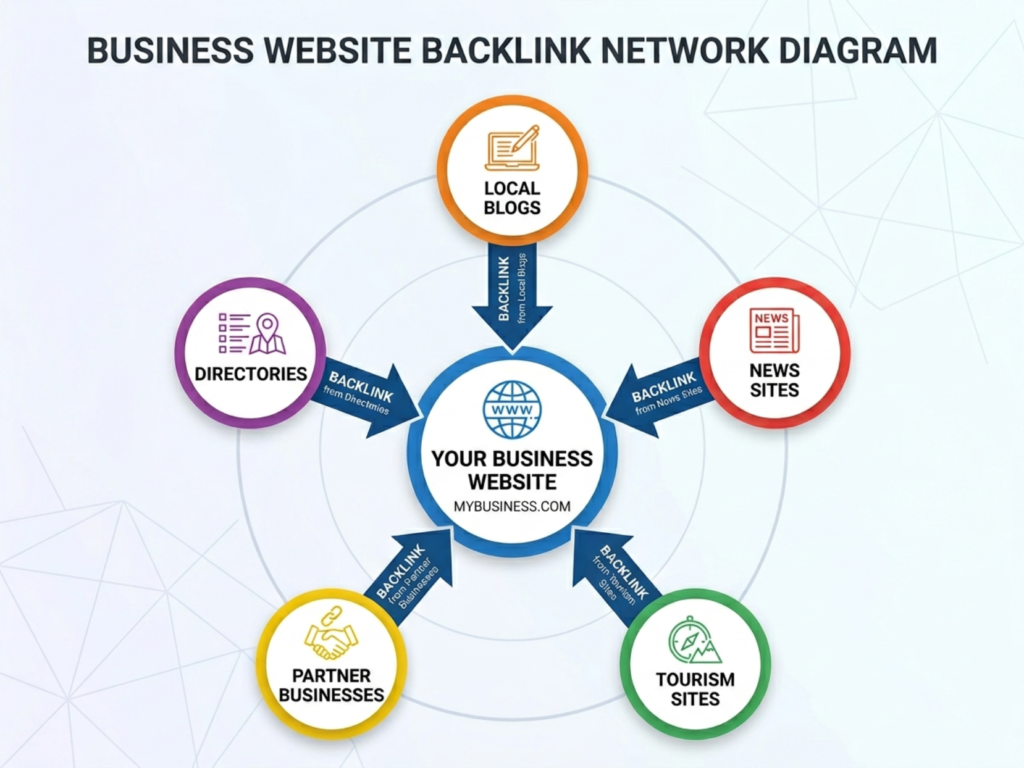
A backlink is when another website links to yours. For local SEO, backlinks from other Sri Lankan websites are especially valuable because they signal to Google that your business is trusted within the local community.
Ways to build local backlinks in Sri Lanka:
- Partner with complementary local businesses (a guesthouse can partner with a nearby tour operator — each links to the other)
- Get listed on Sri Lanka Tourism Board websites and travel blogs
- Contribute articles to local news sites like Daily Mirror, Colombo Gazette, or the Daily FT
- Sponsor local events or community initiatives — event pages almost always link to sponsors
- Reach out to Sri Lankan travel bloggers and food bloggers who write about businesses in your area
- If you have a restaurant or hotel, ensure you are listed on Roar.lk, Yamu.lk, and similar local lifestyle platforms
Step 7: Create Local Content Regularly
Publishing content about your local area helps Google understand that your business is deeply connected to your community. It also gives you more pages to rank for local searches.
Content ideas for Sri Lankan businesses:
- A hotel in Mirissa could write: “10 Things to Do in Mirissa Beyond the Beach”
- A restaurant in Kandy could write: “A Guide to Sri Lankan Rice and Curry: What to Expect as a First-Time Visitor”
- A tour operator could write: “Best Time to Visit Sigiriya: What You Need to Know Before You Go”
- A wedding photographer could write: “Top 10 Wedding Venues in Colombo for 2026”
- A car service centre could write: “How to Prepare Your Vehicle for Sri Lanka’s Monsoon Season”
This type of content serves both local customers and tourists, builds authority, and creates more entry points for Google to send traffic to your website.
Step 8: Use WhatsApp and Social Media to Support Your Local Presence
Sri Lanka has one of the highest WhatsApp usage rates in Asia. While WhatsApp itself is not a direct ranking factor, it supports your local SEO in important indirect ways:
- Use your Google Business Profile link in your WhatsApp Business profile
- After completing a service, send customers your Google review link via WhatsApp
- Share your website content on Facebook and Instagram — social traffic tells Google your content is relevant and being shared
- Keep your Facebook page updated with your correct NAP, photos, and opening hours
Sri Lanka tip: Google Business Profile now allows you to add a WhatsApp number as a contact option. If you run a business where customers typically contact you via WhatsApp before visiting, enable this — it significantly reduces friction for customers.
Step 9: Get Customer Reviews Consistently
This step is important enough to repeat. Reviews are one of the strongest ranking factors in local SEO, and they are also one of the biggest influences on whether a potential customer chooses your business over a competitor.
Target these platforms for reviews:
- Google Business Profile — most important for local rankings
- TripAdvisor — critical for tourism-related businesses
- Facebook — widely used by Sri Lankan customers
- Booking.com / Agoda — critical for accommodation
Set a goal. For example, aim to get at least 5 new Google reviews per month. Consistent, steady review growth tells Google your business is active and trustworthy.
Step 10: Monitor Your Results
Track what is working using free tools:
| Tool | What to Track |
|---|---|
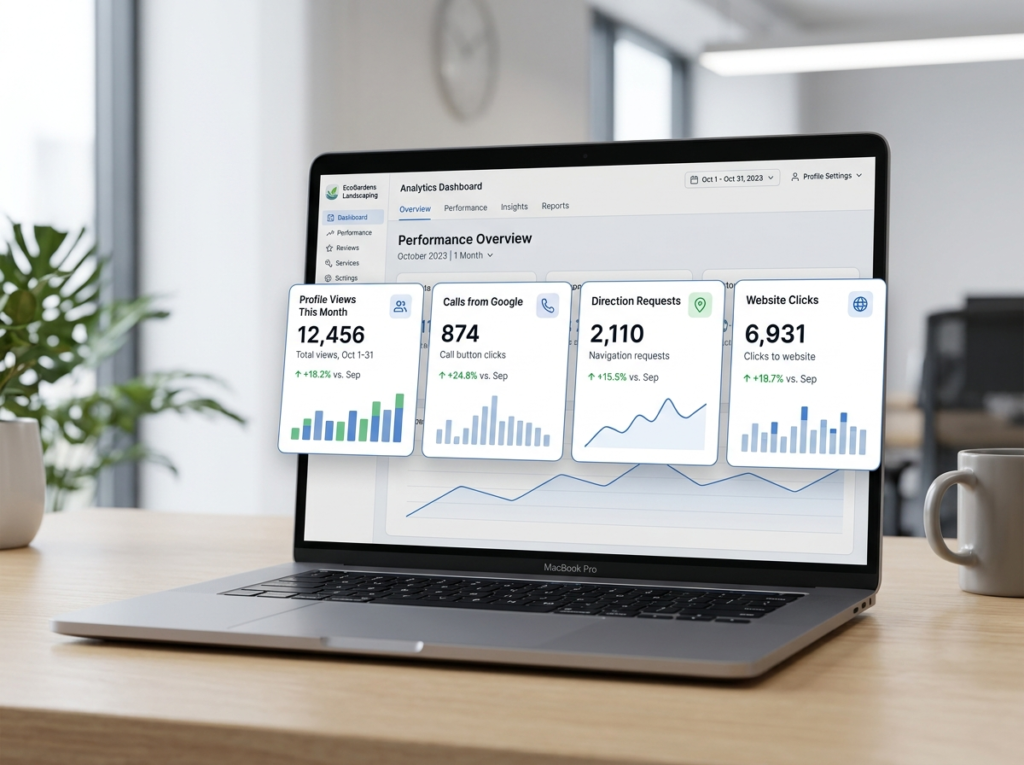
| Google Business Profile Insights | How many people found you via Search vs Maps, how many called or asked for directions |
| Google Search Console | Which keywords are bringing traffic to your site, click-through rates, any errors |
| Google Analytics | Total website traffic, where visitors come from, which pages they visit |
| Google Maps | Check how your business appears and whether the pin location is accurate |
Check these at least once a month. If a particular keyword is bringing traffic, create more content around it. If your profile views have dropped, check whether your information is still accurate.
Common Mistakes Sri Lankan Businesses Make with Local SEO
1. Not Having a Google Business Profile at All
This is by far the most common mistake. Many Sri Lankan businesses rely entirely on Facebook and have never set up their Google Business Profile. This means they are completely invisible on Google Maps and in local search results.
2. Inconsistent NAP Across Platforms
Using different address formats, phone numbers with and without country codes, or slightly different business names across Google, Facebook, and directories sends conflicting signals to Google and reduces your ranking.
3. Ignoring Reviews — Especially Negative Ones
Not responding to reviews, or not asking for them at all, is a major missed opportunity. A business with 150 reviews and an average of 4.2 stars will almost always outrank a business with 8 reviews and a 5.0 average.
4. No Local Keywords on the Website
Having a beautiful website that says nothing about your location is very common among Sri Lankan businesses. Google cannot guess where you are — you have to tell it clearly and consistently throughout your content.
5. Photos That Are Too Dark or Low Quality
Google Business Profiles with bright, clear, professional-looking photos get significantly more clicks than those with dark, blurry, or no photos at all. Sri Lankan businesses often upload one or two photos and stop. Aim for at least 15–20 quality photos including your interior, exterior, products, team, and any certifications or awards.
6. Incorrect or Outdated Business Information
Wrong phone numbers, outdated opening hours, or old addresses create friction for customers and hurt your ranking. Update your profile every time anything changes — especially during Sri Lankan public holidays when your hours may differ.
7. Skipping Structured Data
Most Sri Lankan businesses do not add structured data to their websites because they are not aware it exists. This is actually an advantage for those who do — it is one of the easiest ways to stand out from local competitors.
8. No Mobile Optimization
Sri Lanka is a mobile-first market. A website that only looks good on desktop will lose most of its local visitors immediately.
Free Tools Every Sri Lankan Business Should Use
| Tool | What It Does | Cost |
|---|---|---|
| Google Business Profile | Manage your local listing, appear in Maps and Local Pack | Free |
| Google Search Console | Monitor keywords, track rankings, fix website errors | Free |
| Google Analytics | Track website traffic and visitor behaviour | Free |
| Google PageSpeed Insights | Check your website speed on mobile and desktop | Free |
| Google Keyword Planner | Find keyword ideas with search volume data | Free |
| Google Structured Data Markup Helper | Generate local business schema code for your site | Free |
| TinyPNG | Compress your photos before uploading to your website | Free |
| Ubersuggest (free tier) | Research keywords and check what your local competitors rank for | Free (limited) |
Local SEO for Specific Sri Lankan Business Types
Hotels and Guesthouses
Priority platforms: Google Business Profile, TripAdvisor, Booking.com, Airbnb, Agoda. Focus on getting reviews across all booking platforms. Publish local travel content on your website (things to do nearby, best time to visit, local food guides). Upload a large number of professional photos — accommodation is one of the most photo-dependent categories in local search.
Restaurants and Cafés
Priority platforms: Google Business Profile, TripAdvisor, Facebook. Get listed on Yamu.lk and Roar.lk which are widely used by Sri Lankan food lovers. Post your menu on your Google Business Profile. Update your hours accurately — nothing frustrates customers more than arriving at a closed restaurant that Google said was open.
Tour Operators and Travel Services
Priority platforms: Google Business Profile, TripAdvisor, Sri Lanka Tourism Board directories, travel blogs. Build backlinks by being featured on travel blogs that cover Sri Lanka. Create destination guides for every area you operate in — this is a huge opportunity for local content creation.
Beauty Salons and Spas
Priority platforms: Google Business Profile, Facebook. Reviews and photos are critical. Before-and-after photos (with client permission) perform extremely well. WhatsApp Business integration is very important — most clients will contact you via WhatsApp before booking.
Professional Services (Lawyers, Doctors, Accountants)
Priority platforms: Google Business Profile, LinkedIn, professional directories. Create content that answers common questions your clients have. A lawyer in Colombo who writes a blog post answering “What to do if you have a vehicle accident in Sri Lanka” is targeting exactly the people who will need their services.
Frequently Asked Questions
1. What is local SEO?
Local SEO is the practice of optimizing your business online so it appears in search results when people nearby search for your products or services. It includes your Google Business Profile, your website, customer reviews, and your presence across online directories. For Sri Lankan businesses, it is one of the most cost-effective ways to attract both local customers and tourists.
2. How long does it take to see results?
Most businesses begin to see meaningful improvements within 3 to 6 months of consistent effort. Some changes — like completing your Google Business Profile or correcting your NAP — can show results within a few weeks. Building reviews and content takes longer but produces more lasting results.
3. Do I need a website?
A website is not strictly required to appear in Google local results — your Google Business Profile alone can get you into the Local Pack. However, a website significantly improves your credibility, gives customers more information, and opens up many more ranking opportunities. Even a simple, well-optimized one-page website is far better than none.
4. How important are Google reviews for my Sri Lankan business?
Extremely important. Reviews affect both your ranking and your conversion rate. A potential customer choosing between two similar businesses in Kandy will almost always choose the one with more reviews and a higher rating. Aim to build reviews consistently over time rather than getting a sudden burst and then stopping.
5. My business is in a small town in Sri Lanka — can local SEO still help me?
Yes, and often more than in a big city. Smaller towns and districts have far less competition in local search results. A business in Matara, Trincomalee, Batticaloa, or Vavuniya that sets up a complete Google Business Profile and builds a handful of reviews can often appear in the Local Pack very quickly, simply because so few competitors have done the same.
6. Should my content be in Sinhala, Tamil, or English?
If you primarily serve local Sri Lankan customers, consider adding key pages or your Google Business Profile description in Sinhala or Tamil. If you serve international tourists, English is essential. Many successful Sri Lankan businesses use both — English for their main website content, and Sinhala or Tamil for their Facebook posts and WhatsApp communications. Google increasingly supports and indexes Sinhala and Tamil content in Sri Lanka.
7. What is structured data and do I really need it?
Structured data is a piece of code added to your website that gives Google extra details about your business. It can help your listing show star ratings, opening hours, and photos directly in search results. Most Sri Lankan businesses have not added this yet, which means doing so now gives you an immediate advantage over local competitors.
Local SEO is not a one-time task — it is an ongoing process. But the businesses in Sri Lanka that invest the time to build their local presence correctly will have a significant advantage over competitors in 2026 and beyond. Start with your Google Business Profile today, build your reviews consistently, and take it one step at a time.