How to Improve Your Website’s Ranking in Sri Lanka
A practical guide for business owners who are tired of being invisible online
Let me start with something most SEO articles won’t tell you: ranking well on Google in Sri Lanka is genuinely achievable for most businesses, not because SEO is easy, but because the competition here is thinner than you think. A large portion of Sri Lankan business websites were built years ago, haven’t been touched since, and have no content strategy to speak of.
If you put in consistent, focused effort over six months, you will see results that would take twice as long in a market like India or the UK.
That said, “just do SEO” is about as useful as “just eat less.” So here’s what actually matters, and why.
Improve Your Website’s Ranking in Sri Lanka; Step By Step Guide
Step 01; Start With What People Are Actually Searching For
In this game, before you write a single word of content or touch your website’s settings, you need to understand how Sri Lankan customers phrase their searches. This sounds obvious, but most businesses skip it entirely.
People in Colombo searching for an interior designer don’t search “premium interior design services.” They search “interior designers in Colombo” or “house design Colombo price” or sometimes even a Sinhala-English mix like “gedara design Colombo.” The phrases people use when they’re ready to buy are often simpler and more direct than the language businesses use to describe themselves.
Use Google’s free Keyword Planner 🔗 — set your location to Sri Lanka and your language to English (and Sinhala if relevant). Look at what comes up. Pay attention to the “People Also Ask” boxes when you search Google yourself. Those questions are real things real people are typing.
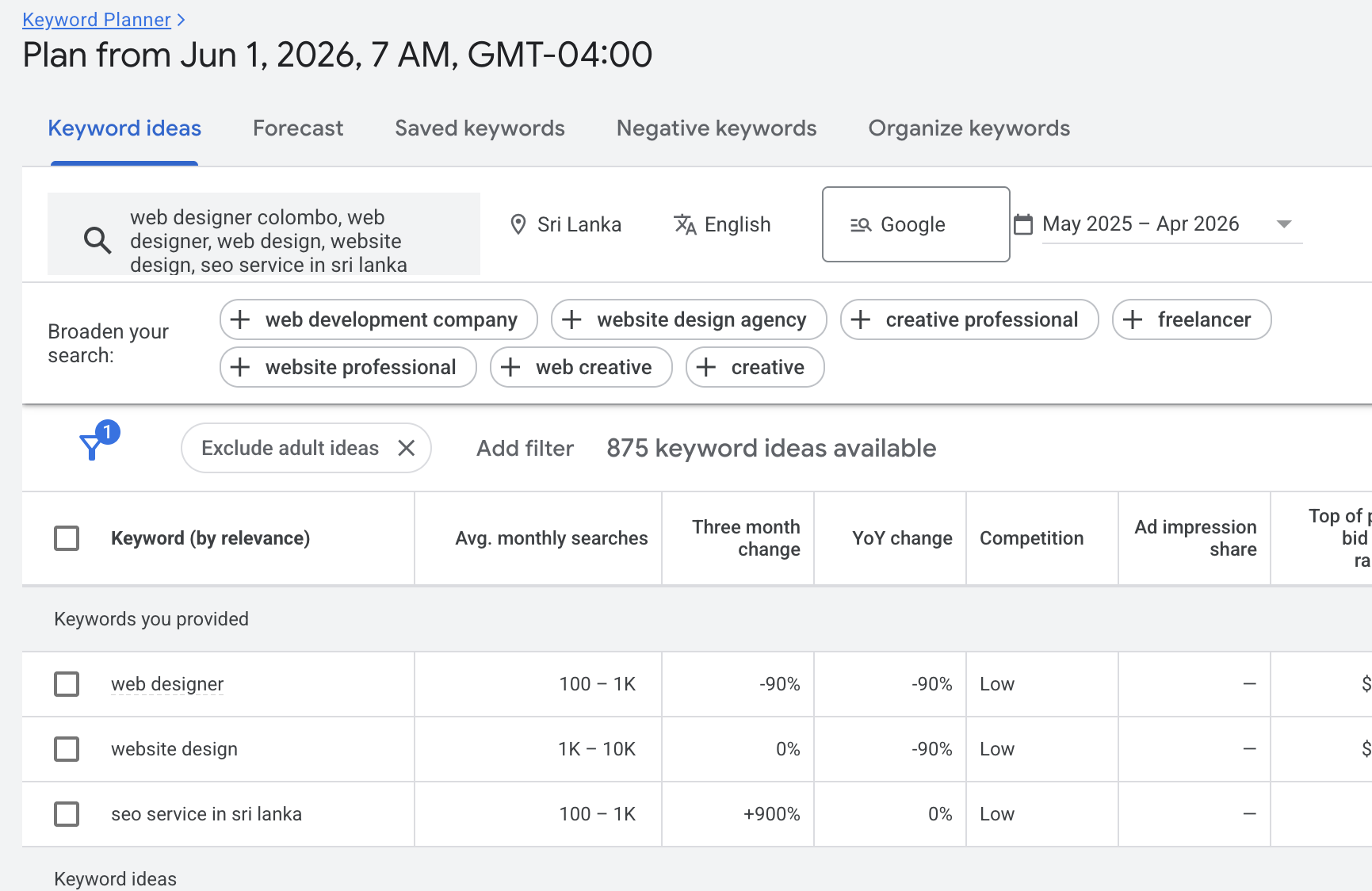
For most Sri Lankan businesses, the golden territory is mid-specificity: not broad (“web developer”) and not overly niche (“agile full-stack JavaScript developer Colombo”). The sweet spot is something like “web developer Colombo” or “affordable website design Sri Lanka.” Enough searches to matter, specific enough that you can realistically rank.
One thing almost no competitor article mentions: many Sri Lankan users search with city + service even when looking for island-wide services. A person in Kandy looking for accounting software will still often type “accounting software Kandy” even if the software is cloud-based and works everywhere. Create pages that speak to these regional searches.
Step 02; Your Google Business Profile Is Not Optional
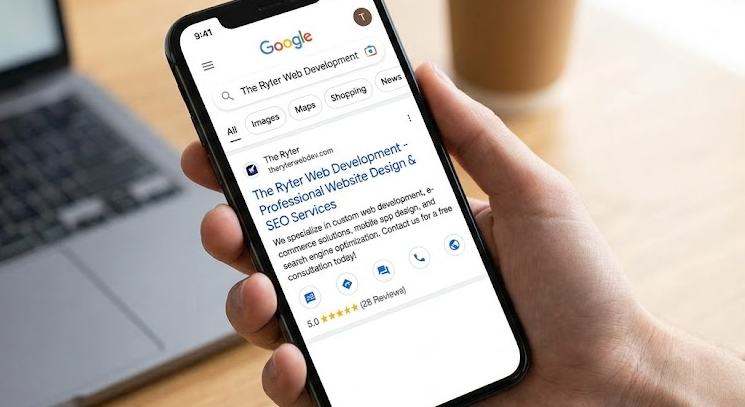
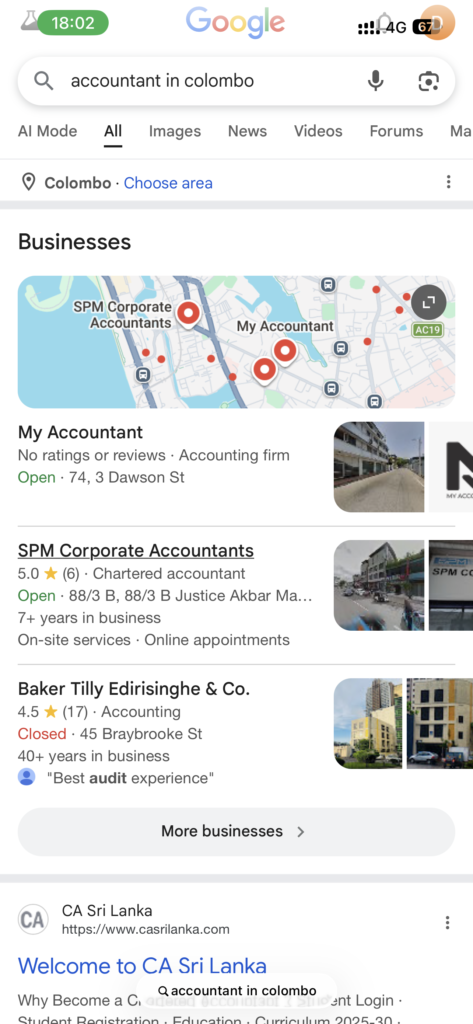
If your business has any local element at all — a physical location, a service area, customers who visit you — your Google Business Profile 🔗 (formerly Google My Business) is the single highest-return thing you can do. Setting it up costs nothing and can get your business appearing in the map pack within weeks, not months.
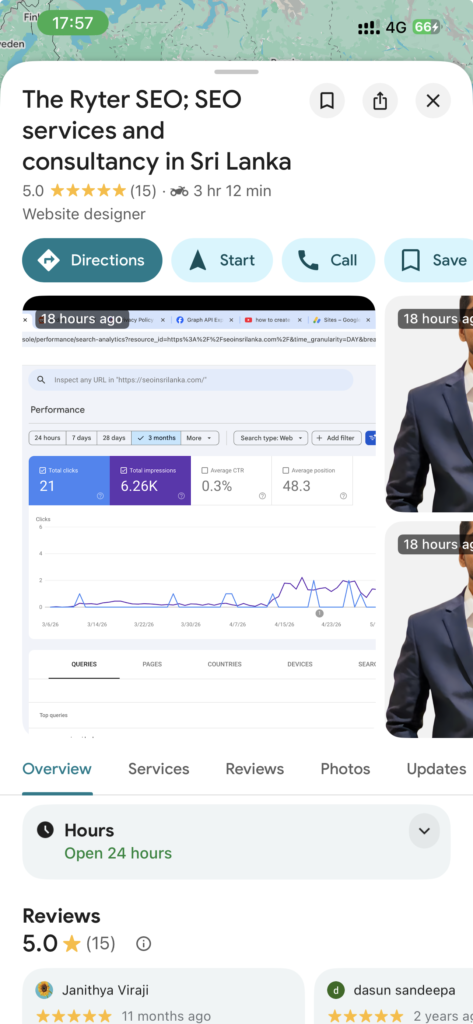
But “setting it up” is not enough. Here’s what most Sri Lankan businesses do: they claim the profile, enter the address and phone number, and leave it. Here’s what you should actually do:
Fill in the description field fully
You have 750 characters — use them to describe exactly what you do, who you serve, and where you operate, including neighborhood or district names. Google reads this.
Add photos consistently, not just once
Businesses with regularly updated photos get substantially more engagement than those with a set of photos uploaded at launch and never touched again. If you run a restaurant, add new photos of your food monthly. If you’re a law firm, photos of your team and office are more valuable than a stock image of scales.
Post weekly updates
Most businesses ignore this feature entirely. A short post about a promotion, a new service, an event, or even just a tip relevant to your industry keeps your profile active and signals to Google that your business is current.
Respond to every review
Not with a template — actually respond to what the person said. If they mentioned the speed of your service, acknowledge it. If they had a complaint, address it specifically. This matters both for Google’s assessment of your profile and for the humans who read reviews before deciding to contact you.
Step 03; Improve the technical SEO of your website (ex:- Site speed, navigation etc. )
Sri Lanka has a mobile-dominant internet population. Most searches happen on phones, often on networks that aren’t 5G. This makes page speed not just an SEO factor but a real user experience issue that directly affects whether someone stays on your page or bounces back to Google and clicks your competitor.
Here’s the reality: most Sri Lankan business websites are slow. Images are uploaded at full resolution without compression. There are five or six plugins running that nobody needed in the first place. The hosting plan was picked based on price, not performance.
Go to pagespeed.web.dev 🔗 right now and type in your URL. You’ll get a score and specific issues. Focus first on images — they’re almost always the biggest problem. Every image on your site should be:
- Compressed before uploading (use squoosh.app 🔗, it’s free)
- Served in WebP format where possible
- Sized appropriately for where it appears (a thumbnail doesn’t need to be a 3MB photo)
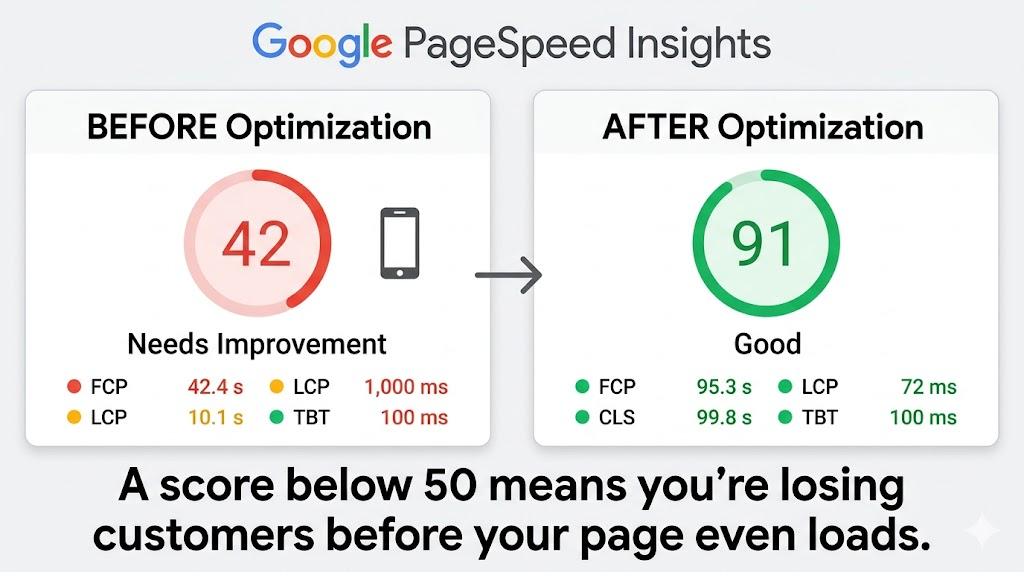
If your site is on WordPress, the WP Rocket or Smush plugins handle much of this automatically. If you’re on a custom build, your developer should be addressing image optimization and browser caching.
A site that loads in 2 seconds versus 5 seconds isn’t just faster — it ranks differently, and it converts differently. People in Sri Lanka, like everywhere else, don’t wait for slow websites.
Step 04; Step What You Put on Your Pages Still Matters More Than Anything Else
Technical SEO and Google Business Profiles are the foundation. But content, what’s actually on your pages, is what builds rankings over time.
Every page on your site should clearly answer one central question: what is this page about, and why should someone searching for X end up here? Google’s job is to match searches with pages. Your job is to make that match obvious.
Writing service pages that actually rank
For a service page, this means writing about the service specifically — what it includes, who it’s for, what results clients can expect, what the process looks like. A page that says “We provide professional accounting services tailored to your business needs” tells Google almost nothing. A page that says “We provide monthly bookkeeping, VAT filing, and tax preparation for small businesses in Colombo, typically saving clients 4–6 hours per month” is actually indexable information.
Blog content: answer real questions, fully
Pick a question your customers actually ask, answer it completely and honestly, and don’t pad it. A 700-word article that fully answers “how much does a website cost in Sri Lanka” will outperform a 2,000-word article that dances around the same question without ever giving a real answer.
Should you write content in Sinhala?
Something no competitor article covers: consider creating content in both English and Sinhala. Competition for Sinhala-language keywords is remarkably low, and searches in Sinhala or in Singlish, the phonetic Sinhala written in English letters are growing fast as mobile internet reaches more of the population.
If your target audience includes Sinhala-speaking customers, a Sinhala version of your key service pages or a Sinhala blog can give you a significant edge.
Step 05; Backlinks: The Part Everyone Wants a Shortcut For
Backlinks — links from other websites to yours — still matter significantly for Google rankings. They function as votes of credibility. A link from the Daily FT 🔗 or the Sunday Times 🔗 tells Google this is a real, legitimate business.
Here’s how Sri Lankan businesses can realistically build backlinks without buying them or participating in link schemes that Google penalizes:
Get listed in Sri Lankan directories
Get listed in trusted local directories — Lanka Business Online 🔗, Sri Lanka Yellow Pages 🔗, and SLASSCOM 🔗 (if you’re in tech). These are modest signals individually but collectively help establish that your business exists and operates where you say it does.
Contribute to local publications
If you have specific expertise — in finance, law, agriculture, hospitality, tech — offer to write a guest piece for a Sri Lankan news site or industry blog. One link from a credible publication is worth more than fifty from random directories.
Build relationships with complementary businesses
If you’re a wedding photographer, a link from a wedding venue’s vendor page, and vice versa, is natural and valuable. These relationships exist anyway — make them digital.
Create content worth linking to
This is the long game, but it works. If you publish the only comprehensive guide to, say, VAT compliance for Sri Lankan e-commerce businesses, or the current regulations for food imports, other websites will reference and link to it over time. Original, locally specific information is the content that earns links organically.
The .lk Domain Question
Should you use a .lk domain? It’s worth a direct answer because many Sri Lankan businesses ask it.
Yes, generally. A .lk domain sends a clear geographic signal to Google about the location of your business, and it builds trust with Sri Lankan customers who recognize the local extension.
If your primary market is Sri Lanka and you already have a .com, it’s worth at minimum registering the .lk 🔗 and redirecting it to your main site. If you’re starting fresh and serving mostly a local audience, a .lk is the natural choice.
Honest Timeline: What to Actually Expect
Nobody wants to hear this, but it needs to be said: SEO takes time. Not because the work is slow, but because Google evaluates patterns and consistency over time, not single actions.
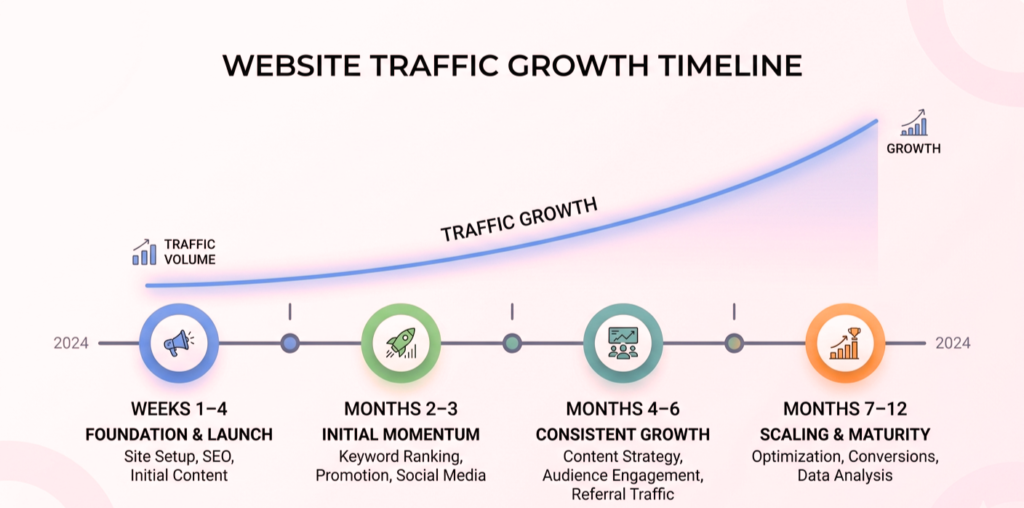
For a new website with a verified Google Business Profile, local keyword targeting, and a technically sound site, you can expect:
- Weeks 1–4: Your profile and site get indexed. You start appearing for very specific, low-competition searches.
- Months 2–3: If you’re publishing content regularly and have no major technical issues, you’ll see initial movement in Search Console. Traffic is still modest.
- Months 4–6: Real traction begins. Pages start ranking on pages 1–2 for targeted keywords. Google Business Profile leads increase noticeably.
- Months 7–12: Compounding effect. Each piece of content contributes, authority builds, rankings stabilize.
For an established website that already has traffic, improvements to technical SEO and content can show results in as little as 4–6 weeks. But sustainable ranking growth is always a 6-to-12 month horizon.
The Sri Lankan businesses that rank well aren’t doing anything magical. They’ve been consistent — with content, with their Google profile, with their technical maintenance — for long enough that the compounding has kicked in.
A Few Things Worth Checking Today
If you want a quick list of actionable items before you get into the longer-term strategy:
- Search your business name on Google. Does the right information appear? Is your address and phone number correct on any listings that show up?
- Open your website on your phone on mobile data (not WiFi). Does it load quickly? Can you tap the phone number to call directly?
- Go to Google Search Console 🔗 and check if your site is verified. If not, verify it today — it’s free and shows you exactly how Google sees your site.
- Check that your site loads on HTTPS, not HTTP. If your browser shows a warning or “Not Secure,” you need an SSL certificate. Your hosting provider almost certainly offers one free.
- Search a service you offer + your city on Google. Where do you appear? That’s your current baseline.
These five checks take under an hour and will tell you more about your SEO situation than most audits costing thousands of rupees.
Improving your website’s ranking in Sri Lanka is not about tricking Google. It’s about making it genuinely easier for Google to understand what you do, where you do it, and why you’re worth recommending. The businesses that grasp this — and act on it consistently — tend to find that over a year or two, SEO becomes one of their cheapest and most reliable sources of new customers.
Start with the five checks above. Pick one bigger item from this guide each week. Don’t try to do everything at once. That’s the approach that actually compounds.
Want a free SEO audit? contact us now.