12 Best SEO Forums and Communities to Join in 2026
“Best SEO forum” is really shorthand for four different things people are looking for: a place to get a technical question answered fast, a place to track algorithm updates as they happen, a place to network with peers at your level, and a place to learn the fundamentals without embarrassment. No single community does all four well — which is why the right answer is usually two or three communities, not one.
This guide breaks SEO communities into their real categories — open forums, Q&A boards, paid masterminds, and chat-based communities (Slack/Discord) — with current membership and growth data, a scoring framework you can apply to any community not listed here, and a section most competing guides skip: what forum participation actually does and doesn’t do for your rankings.
The four types of SEO communities (and what each is actually for)
Open discussion forums (Warrior Forum, Digital Point, BlackHatWorld, WebmasterWorld) — threaded, permanent, searchable archives going back decades. Best for research: your question has probably been asked and answered already.
Q&A boards (Google Search Central Help Community, Moz Q&A, Quora) — structured question-and-answer format, often with accepted-answer marking. Best for specific, answerable problems.
Social/link-aggregator communities (r/SEO and the other SEO subreddits) — fast-moving, algorithmically surfaced, and increasingly indexed by Google itself. Best for staying current and for visibility.
Chat-based communities (Online Geniuses, Traffic Think Tank, Advise.so) — real-time, relationship-driven. Best for networking and getting a same-hour answer from a specific expert, worst for searchable archives.
Knowing which bucket a community falls into tells you what to expect before you join — a Slack group won’t have quality archives, and a 15-year-old forum won’t give you real-time chat.
Quick comparison
| Community | Type | Size (2026) | Best for | Cost |
|---|---|---|---|---|
| Google Search Central Help Community | Q&A | Unlisted, thousands of active threads | Official guidance, indexing/manual actions | Free |
| r/SEO | Social | ~490,000, +~90K/yr | Fast general discussion, visibility | Free |
| r/bigseo | Social | ~135,000 | In-house / agency-level SEO | Free |
| r/TechSEO | Social | ~50,000+ | Technical / dev-adjacent SEO | Free |
| Warrior Forum | Open forum | 730,000+ | Beginner marketing, affiliate crossover | Free / $97/yr |
| WebmasterWorld | Open forum | Smaller, high-signal core | Deep technical analysis | Free / paid Pro |
| Digital Point | Open forum | ~890,000, ~3M threads | Multi-engine SEO, site marketplace | Free |
| BlackHatWorld | Open forum | Large, active marketplace | Case studies (read cautiously) | Free |
| Moz Q&A | Q&A | Active since 2007, smaller today | Beginner-to-intermediate Q&A | Free |
| Quora | Q&A | 400M+ MAU platform-wide | AI Overview visibility, keyword research | Free |
| Online Geniuses | Chat (Slack) | 49,000+ vetted | Networking, hiring, quick answers | Free |
| Traffic Think Tank | Chat + forum | Smaller, vetted, paid | Peer-level strategy | ~$119/mo |
| Advise.so | Chat + forum (Circle) | ~400, tightly curated | High signal-to-noise, operator-level advice | Paid |
| Search Engine Roundtable | News + comments | N/A (news site) | Fastest algorithm-update coverage | Free |
Open forums
1. Google Search Central Help Community
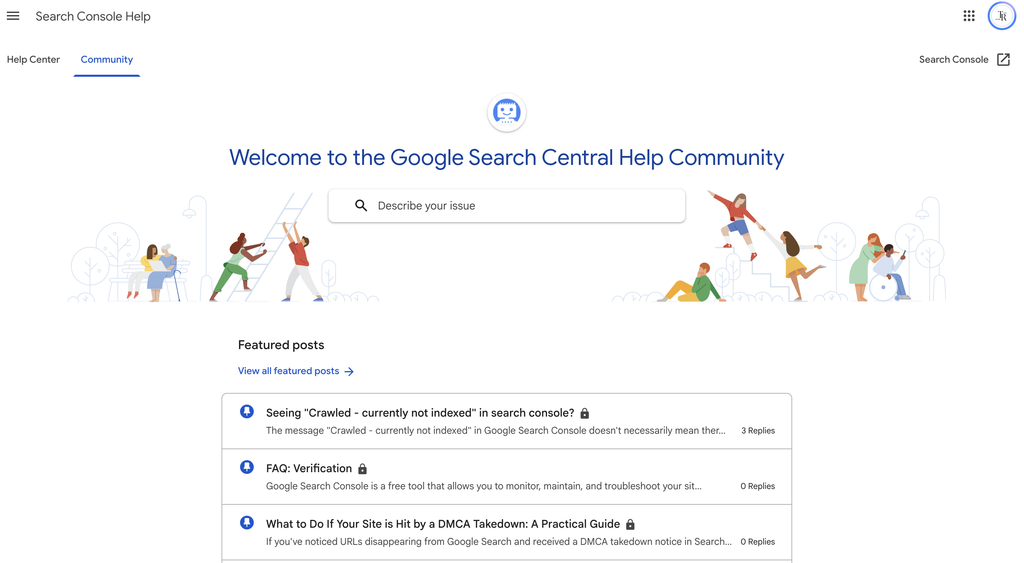
The only community here where you’re occasionally hearing directly from people who work on Search at Google. The Google Search Central Help Community is moderated by Google Product Experts, and Google runs monthly SEO Office Hours on YouTube covering topics that go beyond individual threads.
It’s organized into categories like Crawling and Indexing, Search Console, and Structured Data, with search that surfaces prior answers before you post a duplicate. The limitation: nobody there will diagnose why your specific site underperforms — Google reps are careful to stay general.
Pros:
- Access to Google Product Experts and, occasionally, actual Googlers
- Answers frequently link to official documentation, saving research time
- Years of searchable technical threads mean your issue has likely been solved before
- Available in multiple languages
Cons:
- Direct replies from Google employees are rare
- Site-specific ranking questions usually go unanswered
- Limited to Google Search — no Bing or other engines
- No private messaging between members
2. Warrior Forum
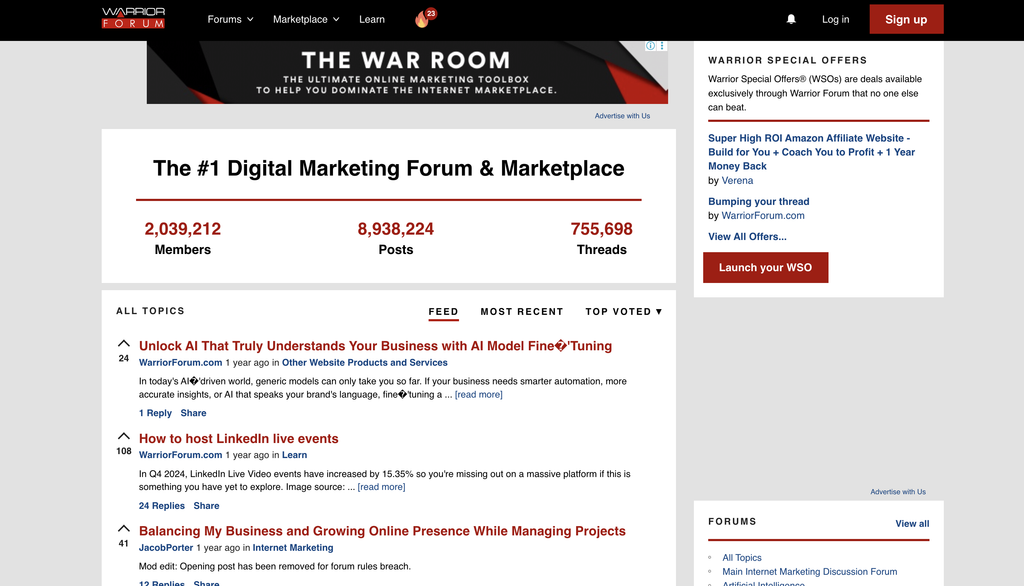
Running since 1997, Warrior Forum has grown to over 730,000 members and remains one of the largest general internet-marketing communities, spanning SEO, copywriting, PPC, and affiliate marketing rather than SEO alone.
Free membership covers most discussion; the paid War Room ($97/year) unlocks a marketplace and additional courses. Good for beginners specifically because of its dedicated newcomer area — the tradeoff is that with nearly three decades of archives, outdated tactics sit right next to advice that’s still accurate.
Pros:
- Massive, decades-deep archive — if someone’s tried it, it’s probably documented
- Genuinely helpful dedicated beginner area
- Active marketplace for tools and services from other marketers
- Regular AMA sessions with practitioners sharing current tactics
Cons:
- Some advanced features and content are locked behind paid War Room membership
- Thread quality varies widely
- Marketplace listings aren’t independently verified
- Slower-moving discussions than Reddit or Slack
3. WebmasterWorld
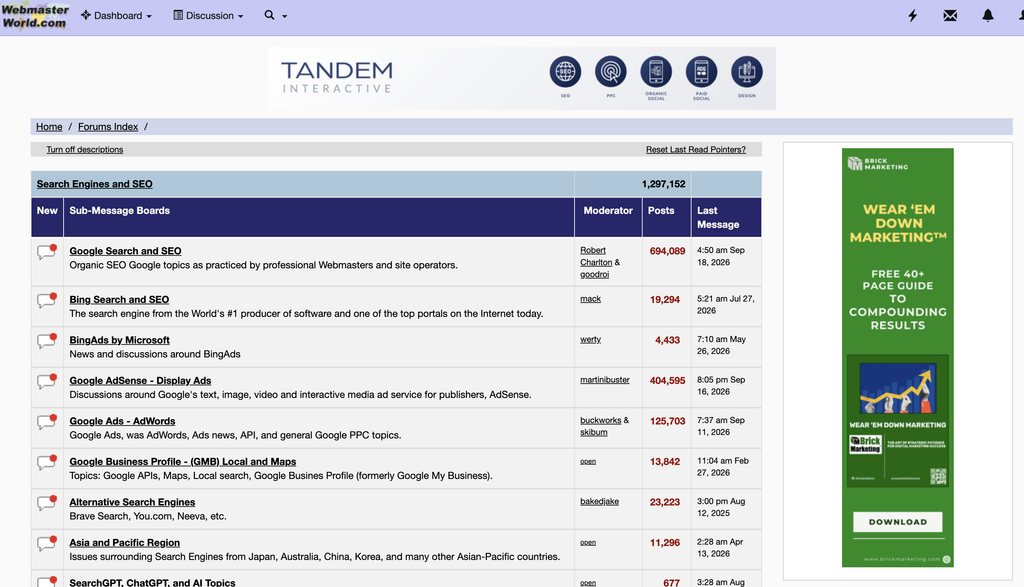
Also live since 1997, WebmasterWorld is built for people who want to understand why a ranking moved, not just confirmation that it did. Its monthly Google Search Observation threads track core updates in near real time as members compare notes across sites during rollout weeks.
There’s no hand-holding here and the interface hasn’t meaningfully changed since the early 2000s, but for raw technical debate it has few real competitors left.
Pros:
- Long-standing reputation for technical depth
- Monthly algorithm-observation threads give real-time data during core updates
- Veteran community with decades of combined experience
- Free to join, with an optional Pro membership for extra features
Cons:
- Dated interface that hasn’t changed much since the 2000s
- Smaller active community than Reddit or Warrior Forum
- Assumes prior knowledge — not beginner-friendly
- Non-Google sections see less activity
4. Digital Point
With roughly 890,000 members across about 3 million threads, Digital Point organizes discussion by search engine — dedicated sections for Google, Bing, and others — so Google-specific threads aren’t buried under unrelated content. It also runs a large marketplace for buying and selling sites, domains, and services; verify sellers independently before transacting, since listings aren’t vetted by the platform.
Pros:
- Extensive subcategories make it easy to find engine-specific discussion
- Large marketplace for buying/selling sites, domains, and services
- Free member tools, including keyword tracking and site-analysis utilities
- Active discussion across digital marketing topics beyond SEO
Cons:
- Some sections noticeably less active than in past years
- Marketplace transactions require extra caution
- Registration occasionally has technical hiccups
- Interface feels dated next to modern platforms
5. BlackHatWorld
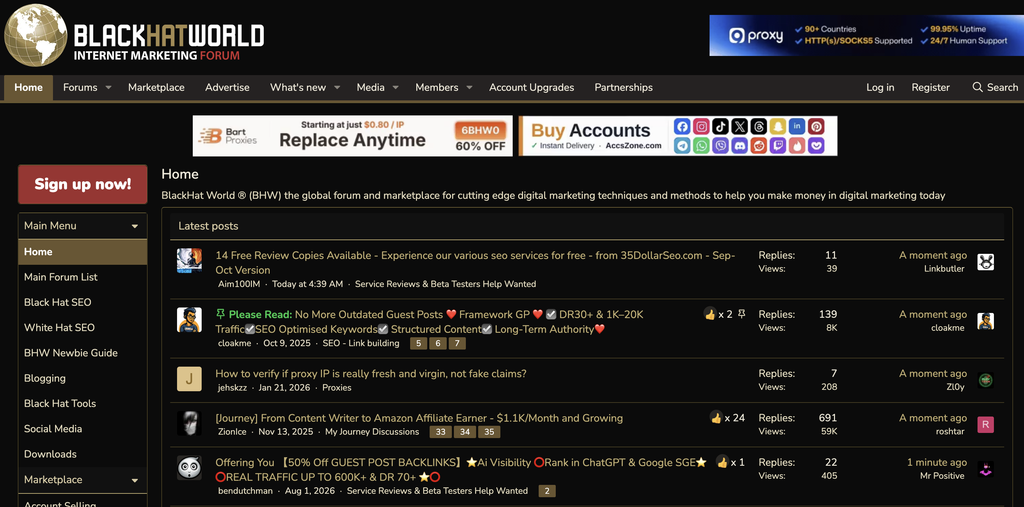
Despite the name, BlackHatWorld has an active White Hat SEO subforum with legitimate, guideline-compliant case studies. Elsewhere on the site, discussion covers manipulative tactics that risk manual actions or full deindexing. Google’s spam detection has only gotten more sophisticated, and the downside — losing rankings entirely — typically outweighs any short-term gain. Treat it as a place to read for awareness, not to copy tactics from directly.
Pros:
- Extensive category structure covering different SEO approaches
- Active marketplace with seller ratings to help vet providers
- Dedicated White Hat SEO section for guideline-compliant tactics
- Detailed case studies and ranking experiments not found elsewhere
Cons:
- Black hat techniques violate Google’s guidelines and can tank rankings overnight
- Some listed services actively violate search engine guidelines
- Advice needs careful vetting — some of it will actively hurt your SEO
- The forum’s reputation may raise eyebrows with clients or employers
Q&A communities
6. Moz Q&A
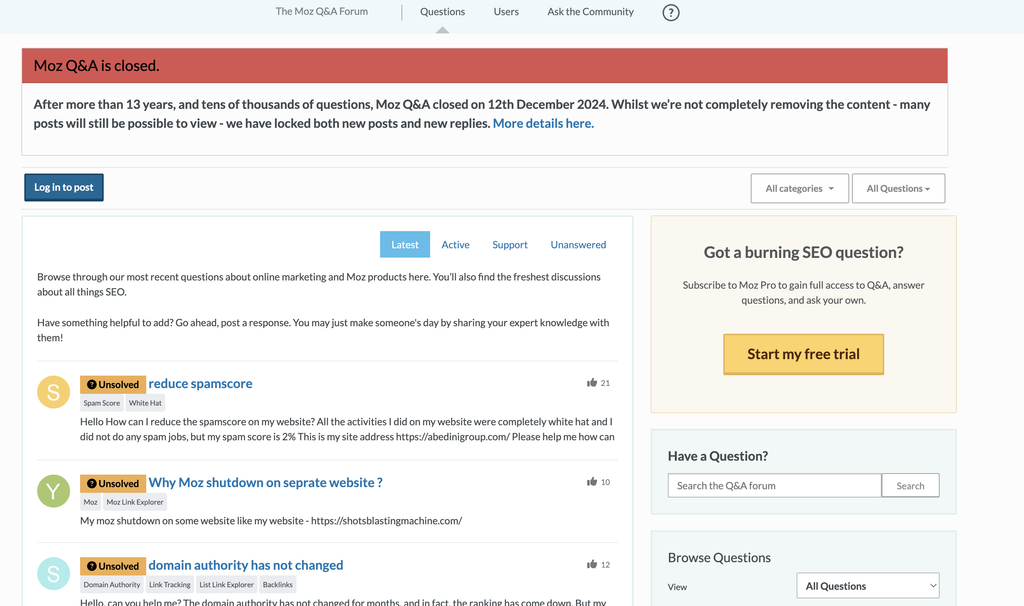
Moz Q&A was once a popular place for SEO professionals to ask questions and share knowledge. However, it is no longer accepting new questions and has been closed for new Q&A activity since 2024.
You may still find older discussions and answers useful for learning about SEO concepts, but it is no longer an active community for asking new questions or getting current SEO advice.
Pros:
- Answers come from long-time working practitioners, not just enthusiasts
- Accepted-answer format is faster to scan than open threads
- Categorized by skill level, from beginner to advanced technical SEO
- Backed by Moz’s broader SEO learning resources
Cons:
- Much quieter than it was a decade ago
- Smaller volume means narrower topic coverage than larger forums
- Interface feels dated compared to newer Q&A platforms
- Response times can lag on niche questions
7. Quora
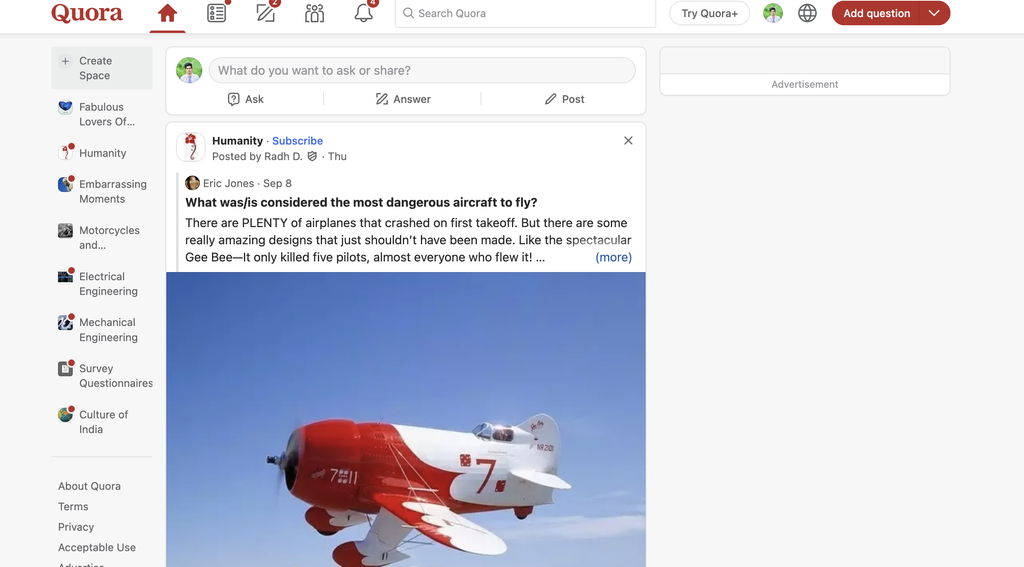
Quora answers regularly surface in Google’s People Also Ask boxes and AI Overviews, giving contributors visibility well beyond the platform itself. It also doubles as a free keyword-research tool: find the exact phrasing your audience uses to ask a question, then build content that answers it directly.
Quora Spaces let you build a niche topic community similar to a subreddit. The tradeoff: links are nofollow, so the value is authority and visibility, not link equity.
Pros:
- Answers frequently surface in Google results and AI Overviews
- Quora Spaces let you build niche topic communities
- High domain authority helps establish contributor credibility
- Easy to search for specific questions and topics
Cons:
- Not structured like a traditional threaded forum
- Links are nofollow — no direct link-equity value
- Content quality varies dramatically by topic and contributor
- Heavy moderation can remove promotional content without warning
Social / aggregator communities
8. r/SEO
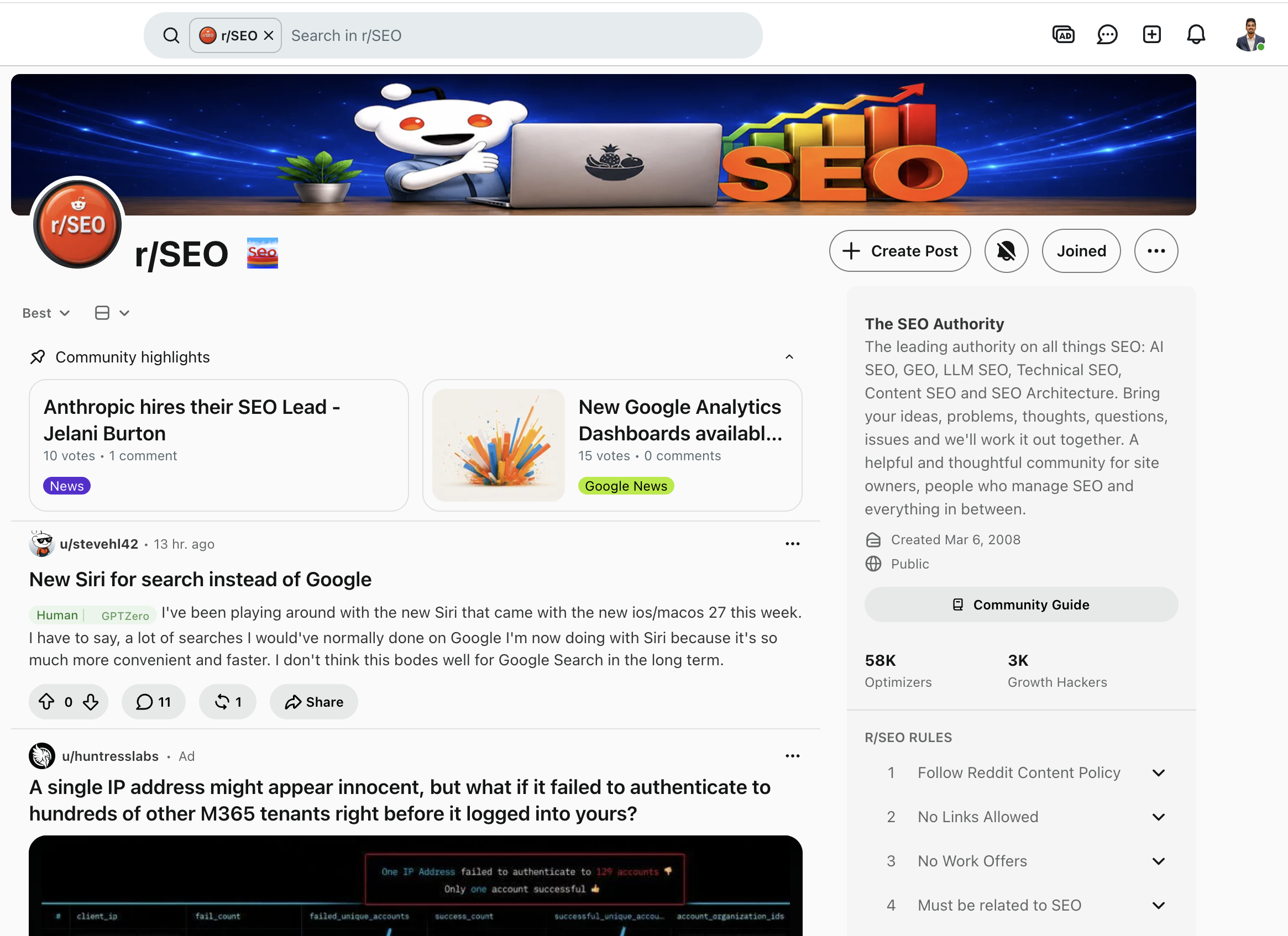
Reddit’s general SEO subreddit has grown fast — sitting around 490,000 members and adding roughly 90,000 a year, one of the fastest-growing SEO communities anywhere.
Reddit threads also rank directly in Google’s results for SEO queries, and Reddit’s footprint in Google search results roughly tripled between early 2024 and early 2025 as real human discussion became a heavier-weighted signal — part of why r/SEO threads now regularly outrank blog posts covering the same questions.
Related subreddits:
- r/bigseo (~135K members, skews enterprise/agency),
- r/TechSEO (~50K+, skews technical/developer),
- r/Local_SEO (smaller but focused specifically on Google Business Profile and local ranking factors).
Pros:
- Fast-moving discussion with real-time community insight
- Threads often rank in Google results, making answers easy to find later
- Occasional replies from actual Google team members
- Free to join, with active moderation keeping spam low
Cons:
- No structured subcategories within r/SEO itself
- Answer quality varies depending on who responds
- Strict self-promotion rules limit link sharing
- Upvote system can bury valid but unpopular viewpoints
9. Search Engine Roundtable
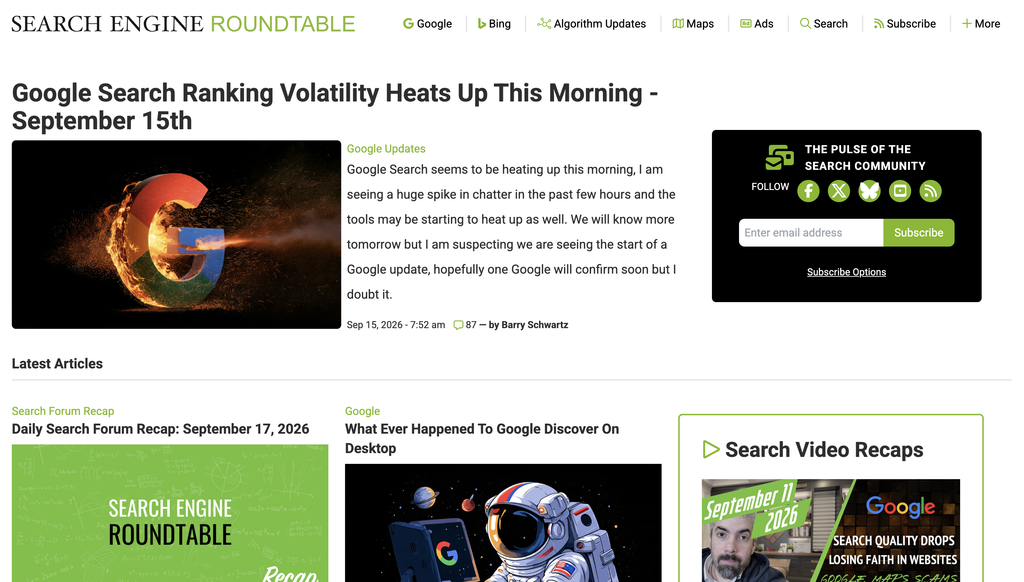
Not a forum in the traditional sense, but Barry Schwartz’s Search Engine Roundtable breaks Google algorithm news faster than almost any other outlet, and its comment sections function as an informal discussion space where industry professionals add context and data. Best used as a daily-news habit rather than a place to post your own questions — there’s no way to start a new thread the way you would on a proper forum.
Pros:
- Lightning-fast coverage of Google algorithm updates
- Highly authoritative — regularly cited by major publications
- Comment sections add expert perspective beyond the article itself
- Completely free to read
Cons:
- A news site with comments, not a true discussion forum
- Not designed for asking questions or getting direct site help
- Heavy Google focus — minimal coverage of other search engines
- No private messaging or member profiles for networking
Chat-based communities (the category most lists skip)
10. Online Geniuses
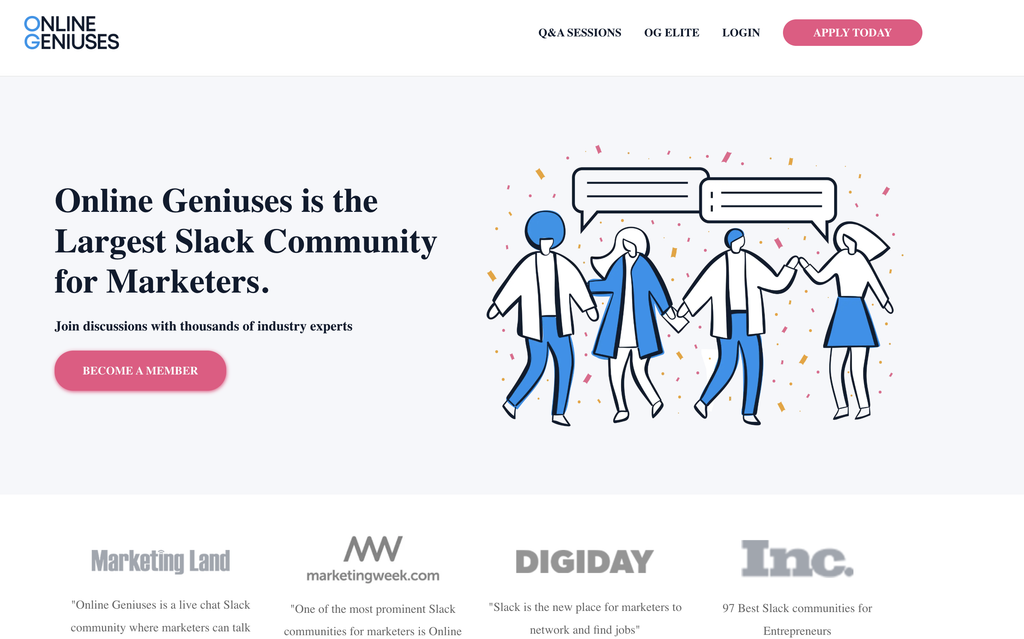
A free, manually vetted Slack community — Online Geniuses — with over 49,000 members spanning SEO, paid media, and broader digital marketing, including VPs, CMOs, freelancers, and agency owners.
It runs 10+ specialized channels (including a dedicated #seo channel), has facilitated hundreds of hiring connections through its #hiring channel, and periodically hosts AMAs with well-known industry figures.
The real-time format means you’ll get an answer in minutes during active hours — the tradeoff is that nothing is easily searchable months later the way a forum thread is.
Pros:
- Large, active, manually vetted membership
- Real-time answers, often within minutes during peak hours
- Dedicated hiring channel has led to hundreds of job connections
- Occasional AMAs with well-known marketing figures
Cons:
- Free tier requires a vetting/application process to join
- Conversations aren’t easily searchable once they scroll past
- Broad marketing focus means SEO is one channel among many
- Quality can dip outside peak activity hours
11. Traffic Think Tank
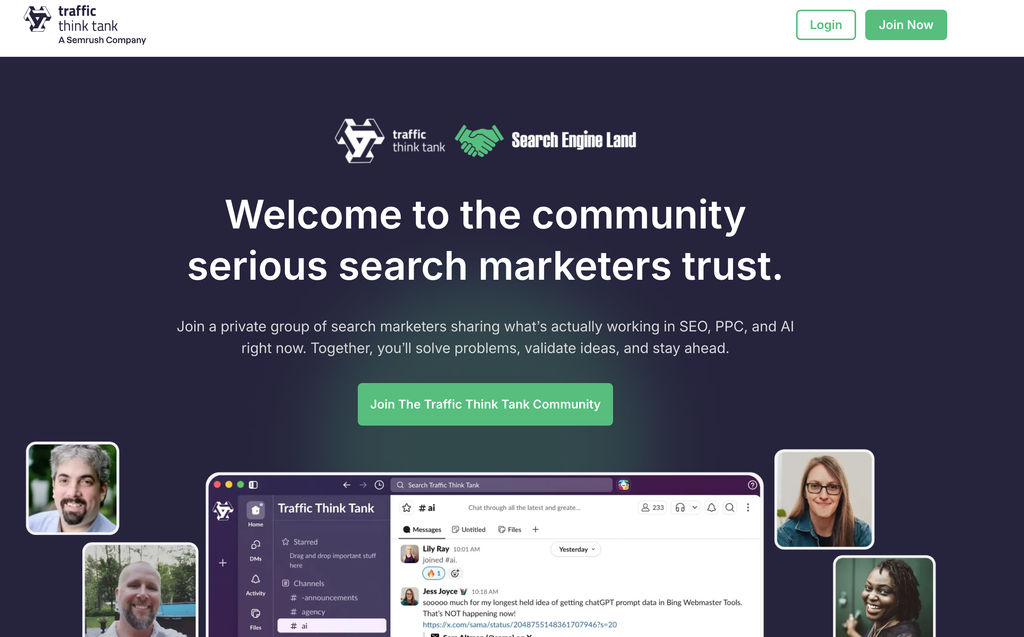
The most established paid community on this list, Traffic Think Tank combines a Slack workspace with a structured forum and monthly live Q&As from working practitioners. Membership is vetted, which keeps the signal-to-noise ratio far higher than any open forum, at roughly $119/month.
Best suited to people who already know SEO fundamentals and want peer review from professionals doing the work daily, not another “what is SEO” thread.
Pros:
- Vetted membership keeps discussion at a consistently high level
- Combines real-time Slack chat with a structured, searchable forum
- Monthly live Q&As with working practitioners
- Access to a structured training library (the Academy)
Cons:
- Recurring cost (~$119/month) is a real barrier for beginners
- Overkill if you’re still learning SEO fundamentals
- Smaller than the big open forums, so fewer historical threads
- Value depends heavily on how actively you participate
12. Advise.so
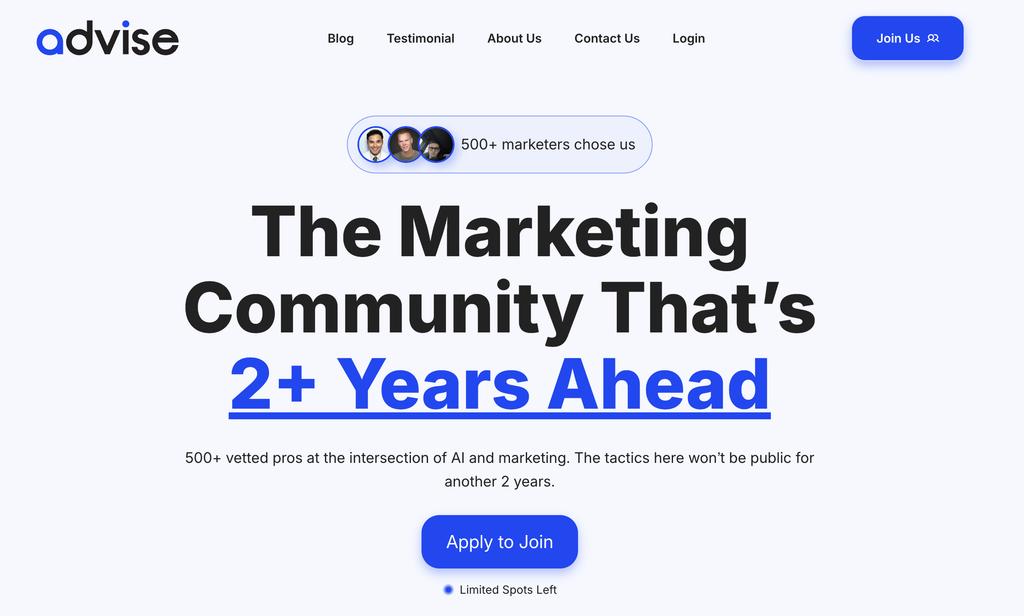
A smaller, more curated community — Advise.so — built on Circle with both forum and live-chat spaces, around 400 members total. That small size is the point: a much higher ratio of senior practitioners to lurkers than Online Geniuses or Traffic Think Tank.
Worth it once you’ve outgrown free communities and want direct access to people actively running campaigns, not just discussing theory.
Pros:
- Very high ratio of senior practitioners to beginners
- Both forum-style archives and live chat in one platform
- Discussion tends toward emerging tactics before they go mainstream
- Small enough that contributions actually get noticed
Cons:
- Paid membership with a comparatively high barrier to entry
- Small member base means narrower range of perspectives
- Less useful if you need answers on SEO fundamentals
- Niche enough that it won’t suit generalist marketers
Niche and adjacent communities worth knowing
- Indie Hackers (SEO tag) — an active SEO-adjacent thread ecosystem where bootstrapped founders share real traffic and revenue numbers alongside tactics, a level of transparency rarely seen on pure SEO forums.
- r/Local_SEO and local-search-focused threads on WebmasterWorld — the go-to spots for Google Business Profile, map-pack, and multi-location questions that general SEO forums handle poorly.
- Platform-native ecommerce communities (Shopify Community, BigCommerce forums) — for ecommerce-specific technical SEO (faceted navigation, canonicalization on product variants), platform-native forums outperform general SEO forums whose advice doesn’t map cleanly onto platform quirks.
A framework for evaluating any SEO community
Rather than trusting a “best of” ranking blindly, apply these four checks to any community — including ones not on this list:
- Response latency. Open five recent threads. If unanswered posts are sitting for a week or more, the community is too quiet to rely on for time-sensitive issues.
- Answer sourcing. Do responses cite documentation, data, or personal test results — or just repeat conventional wisdom? Communities heavy on the latter train you to cargo-cult tactics.
- Moderation visibility. Active moderators who enforce clear rules keep spam and unverified marketplace listings out. An unmoderated forum degrades fast.
- Archive depth vs. real-time value. Decide what you actually need — searchable historical answers (forums, Q&A boards) or same-hour access to a live person (Slack/Discord). Joining a chat community expecting forum-style archives is the most common mismatch.
What forum links actually do for SEO (the part most guides skip)
Before treating community participation as a link-building tactic, know this: Reddit, Quora, and most major discussion platforms mark outbound links rel="nofollow ugc" by default, and Google’s John Mueller has said repeatedly that these links don’t pass PageRank. The same is true of general discussion areas on Digital Point and Warrior Forum.
So why participate at all? Because the value isn’t the backlink itself — it’s:
- Referral traffic from people who click through because your answer was genuinely useful, not because a link existed
- Brand mentions, which search engines increasingly weigh as a trust signal independent of whether the link is followed
- Topical authority signals — consistently useful contributions in a niche build the kind of recognizable expertise that underlies Google’s E-E-A-T (Experience, Expertise, Authoritativeness, Trustworthiness) framework, even without a direct link
- Visibility inside AI-generated answers, since tools like AI Overviews and Perplexity cite Reddit and Quora threads at a disproportionately high rate relative to their raw link authority
- Early intel on algorithm changes, days or weeks before official documentation catches up
If a service is selling “forum posting for backlinks” as a core SEO tactic, that’s a holdover from a pre-2015 understanding of how these links function. Use forums for learning, visibility, and relationships — not as a link-acquisition channel.
How to actually get value once you’ve joined
Ask with specifics. “My WordPress site dropped 40 positions for [keyword] after the last core update — here’s my Search Console data” gets a real answer. “Why isn’t my site ranking?” gets ignored.
Search before posting. Most forums here have 15+ years of archives. Your question has likely already been answered — use the search bar before starting a new thread.
Give before you take. Communities are reciprocal. Sharing your own case studies and results earns better responses over time than only asking and disappearing.
Cross-check advice against primary sources. Validate anything significant against Google Search Central’s official documentation before implementing it site-wide — forum advice varies enormously in quality and context.
Read the self-promotion rules first. Every community here handles self-linking differently. Getting banned for violating rules you didn’t read costs you the community permanently.
Frequently asked questions
Which SEO community is best for absolute beginners?
Warrior Forum‘s beginner section and Moz Q&A are the most approachable — both assume less prior knowledge than WebmasterWorld or Traffic Think Tank.
Do forum or Reddit backlinks help my rankings directly?
No — most are nofollow. The value comes from referral traffic, brand visibility, and topical authority, not link equity.
Is a paid community like Traffic Think Tank or Advise.so worth it over free alternatives?
If you’re past fundamentals, generally yes — vetted membership filters out beginner noise and gets you closer to practitioner-level advice than open forums typically offer.
Is BlackHatWorld safe to use?
The White Hat SEO subforum is fine to read and learn from. Techniques discussed elsewhere on the site risk manual actions or deindexing — treat it as a source of awareness, not implementation.
What’s the difference between a forum and a Slack/Discord community for SEO?
Forums build permanent, searchable archives you can reference years later; Slack and Discord are real-time and better for immediate networking, but conversations are effectively unsearchable once they scroll past.